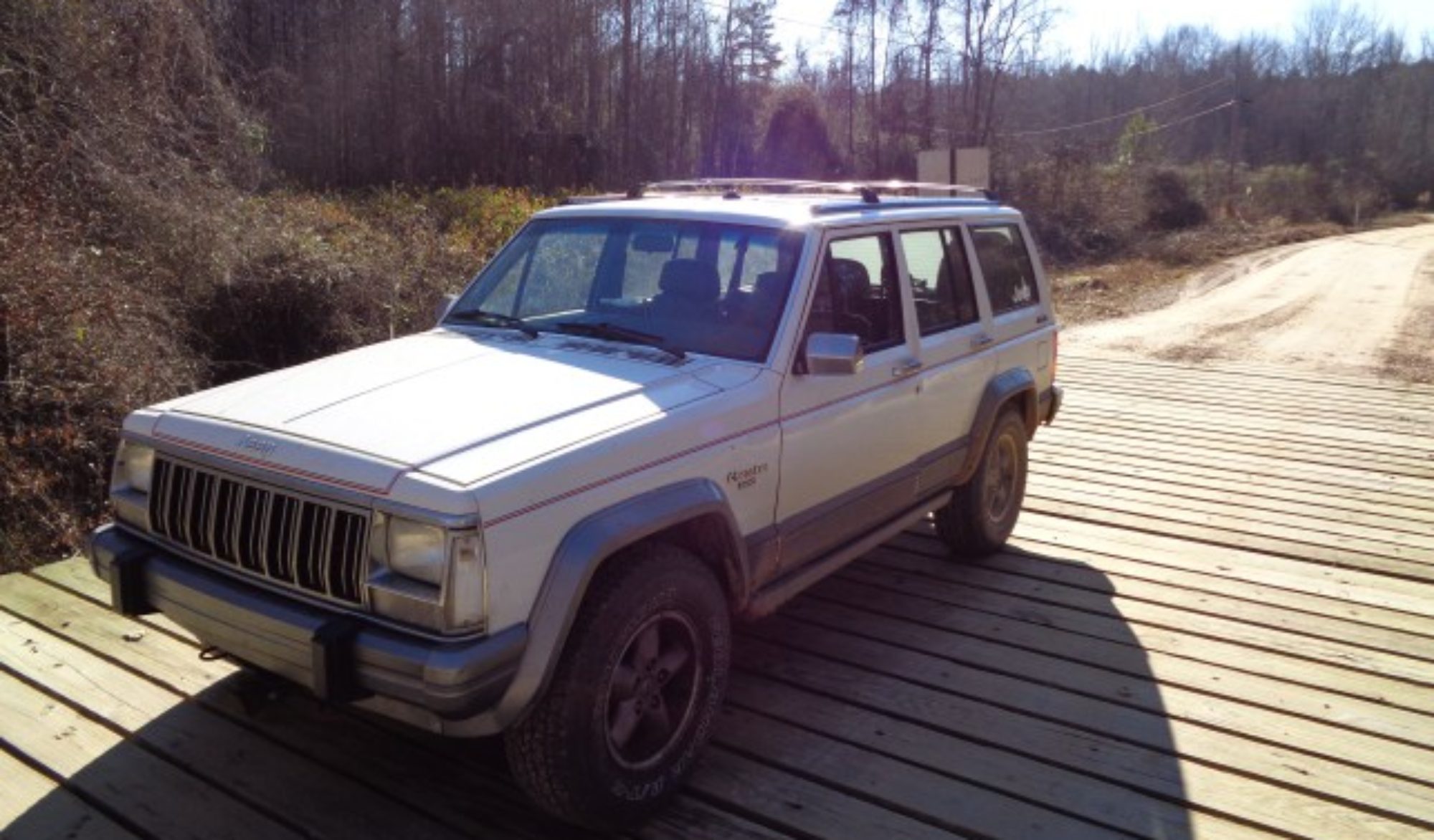
Spare axle storage in an XJ

Spare axle storage in an XJ

After watching several fellow Jeepers break axle shafts in their Dana 30 front ends and having broken two myself I like to carry spares and the tools to swap them out. I think our record time for swapping an axle shaft on the trail is 14 minutes.

However, I have had trouble finding a good place to store the spares. They are heavy and tend to bang around if not secured. They would be a severe hazard if unsecured in a roll over.

I found both short and long shafts will fin inside a length of 4” PVC pipe that can lie cross wise in the rear floor up against the roll cage main hoop in my Cherokee. I don’t have a back seat in mine.

To make the storage pipe, I bought a 10 foot length of PVC sewer pipe. It is about half the price of regular PVC pipe. I also got two caps. The caps for sewer pipe are about a third the cost of pressure caps.

I cut the pipe with a hand saw just long enough to accommodate the two axles overlapped in the tube. It just barely fits between the sides of the XJ. I did not make a separate hold down bracket as I sat the spare tire on top of the tube and secured the tire with two ratchet straps. I don’t think it is going anywhere.

I then used the rest of the pipe to make a sleeve to keep my HI Lift, and axe together. For about $15 I have cleaned up the storage area of my Jeep and hopefully reduced the things that could hit me in the head in an incident.

Auto Repair Chemicals

Auto Repair Chemicals

Generally I tend to be skeptical of the whole solutions in a bottle section of the auto parts store. However, I have had a couple of major success recently that has changed my mind.

First was my shop lift. It had a horrible screech every time it went up and down. It was worse with heavier vehicles and I got to where I was scared to lift my Suburban. I was doing research on where to buy replacement sliders when I did some more careful listening to where the noise was coming from. I pinpointed the noise to the chain roller. A couple of shots of WD-40 totally eliminated the noise. I can’t believe I had been putting up with his noise for six months and it was eliminated with a quick shot of WD-40.

Next, I noticed that my High mileage Jeep Cherokee was a bit sluggish when putting it into reverse each morning. I changed the fluid and filter but that did not help. On the advice of a mechanic friend I tried a bottle of Trans-X. As usual, I was skeptical, but a few days after adding the chemical, my Jeeps transmission was acting normal again. Certainly a good way to spend $10.

After these two successes, I decided to try a bottle of Lucas stop leak on my very leaky power steering pump seal. I really was not in the mood to change the pump and it howled every morning when cold and lost a lot of fluid through the seal. Just half a bottle of Lucas completely stopped the leak and within a couple of days the howl was gone as well.

I still don’t believe in the claims of an engine rebuild in a can or some of the other exaggerated claims, but in the right circumstances, some of the auto repair chemicals are well worth their money.

Almost Alloy kit for Dana 30 from Iron Rock

Almost Alloy kit

Almost Alloy kit for Dana 30 from Iron Rock

The weak link in my XJ has been the front axle U joints I have broken at least three of them. Every time it looks like the cap comes loose and hits the ball joint. Every time it takes the ears off the end of the shaft. I even lost a very expensive ARB shaft this way.

I have looked into the various ways to retain the caps better. There are full circle clips, or the caps can be welded in place. But none of these solutions add any strength to the ears. The ears seem to be the weak point to me. I am guessing the ear flexes and allows the cap to spin causing the clip to come off.


The Almost Alloy kit is a set of tabs that weld on over the ears reinforcing the area and trapping the cap in place. I like the extra strength the plates give to the ears.

I was very unsure about welding them over the caps. I am sure I will never be able to get them off if I need to replace the U joints. So I put in fresh U joints just to be sure. I packed in some extra grease to try to compensate for the grease that would be forced out by the heat of welding. I am not sure that helped at all, but it made me feel better.

I did several practice welds on some scrap that was about the same thickness as the plates to get the heat just right on my MIG. I then cleaned the ears really well with a flap disk and used some brake cleaner to make sure all the grease was gone in the weld area.

I centered the hole in the plate over the center of the U joint cap and welded both sides of the plates. It was not as difficult as I expected to weld to the cast ears.

I then ground down the excess weld bead as there is not a lot of extra room around where the yoke sits in the axle housing. There is plenty of room for the plates, but not for any excess weld bead.

Once the caps were welded, I cleaned up the assembly and put a light coat of paint on it. I then pulled my old axle shafts and replaced them with the armor-plated ones. I will keep the old shafts as spares. But hopefully, with the new protection, I won’t need them.


See ironrockoffroad.com for more info.

How to change the Fluid and Filter in a Jeep Cherokee AW4 transmission

How to change the Fluid and Filter in a Jeep Cherokee AW4 transmission

My Cherokee was long overdue for a fluid and filter change. While I have changed the filter for many others I have neglected my own for far too long. I finally decided to remedy that and with over 360,000 miles on the odometer, I finally decided to open the case.

The transmission pan has the dip tube attached to it. Ideally, you can leave the dip tube attached to the bell housing and just remove the pan. This seldom works for me. So before I lifted the Jeep, I removed the 13mm headed bolt that holds the dip tube to the bell housing.

I continued by supporting the transfer case on a stand and removing the cross member. The transmission mount is held in place by for nuts with 13mm heads. A deep socket is helpful to get them loose. Then the cross member is held to eh body by four 15mm fasteners. While it appears you can get to the back bolts with the cross member in place, you really can’t and it saves time overall to just remove the cross member.

Next I removed the drain plug and let the oil fluid drain out. It was pretty dark but looked OK.

I then used a wire brush and a scraper to remove years of dirt and mud off the pan bolts. It took a while to find them all. While cleaning, I took the new gasket out of the box and laid it in the sun and set some weights on it to try to flatten in out. It was pretty wrinkled in the box.

Once I found all the bolts, I counted the holes in the new gasket to know how many I was looking for; I removed them with a 10mm socket. I had to pry the pan gently away for then bottom of the transmission. As usual, I bent on corner before it separated from the sealant.

With the pan loose, I twisted the dip tube around to allow the clip to clear the bell housing and removed it as a unit. Once it was on the floor, I was able to pull the pipe out.

Next I removed the bolts that held the filter in place and carefully removed it. The old gasket stuck to the transmission so I had to scrape it off. It inspected the old filter and lit looked fairly clean. I installed the new filter with the original bolts.

I removed and cleaned the two magnets in the pan. There was very little metal on them. Not bad at all for 360,000 miles. After wiping out the pan, I took it to the anvil and straightened the corner I bent getting it loose. I then used a wire brush to clean the remainder of the old sealant off the pan.

I used a scraper to clean the bottom of the transmission. I then replaced the magnets in the pan. I slid the dip tube up into its approximate position. I then had to use a heat gun to get the gasket flat enough to work with. I started four bolts in to the pan to hold the corners of the gasket in place.

I then started all the bolts before running any of them down. I had to wiggle the pan around some to get all the gasket holes to line up properly. Once they were all in place, I tightened them gently to compress the gasket evenly. I then set the dip tune in place and pushed it down as best I could from below. I reinstalled the drain plug and cross member. After lowering the Jeep, I pushed the dip tube fully into place and bolted it back to the bell housing.

I then added a gallon of Dextron ATF fluid and started the engine. Finding no leaks, I let it warm up a while and re checked the level. It was just about right.

I was disappointed that the slight hesitation I had when cold was not corrected by the fluid and filter change however. Even after a week of driving with fresh fluid, it still too a few extra seconds to engage reverse on cold mornings.

On the advice of a mechanic friend, I added a bottle of Trans X to the fluid. I have always been very reluctant to try to solve performance issues with chemicals but he assured it me it would do no harm to try. So I poured it in and hoped for the best.

After a few days the transmission was back to its old self with no more hesitation on cold mornings. Hopefully it was just a sticky spot and all will be well for another 100,000 miles or so.

Heater Treater Blend Door Repair

Heater Treater Blend Door Repair

1999 Jeep Cherokee XJ

Janice’s Jeep Chreokee has had trouble regulating the temperature in the cabin. Eventually the warm / cool knob made no difference at all. It was cold all the time.

I remembered the previous experience of pulling the HVAC box to replace the heater core. That was a job I do not care to repeat. I also remembered that I had a lot of trouble getting the blend door to sit properly in its hinges when I reassembled the box.

I first checked the actuator and saw it moved in response to the knob on the dash. I had had trouble with my GMC Suburban that turned out to be the HVAC controller. Since the actuator was moving but the temperature was not changing, I knew something had to be wrong with the blend door.

A quick Google search showed this to be a common problem on the 97 to 01 Jeep Cherokees. The door is plastic and will break. Once I got mine out, I found it was indeed broken where the drive actuator engages it.

While searching for solutions, I found HeaterTreater.com. They offer a metal replacement blend door along with a procedure that allows the door to be replaced from the foot well without removing the box. At first, I thought the $119 price was high but it sounded better than removing the box again. Especially since the Freon has to be removed to pull the box.

I put the kit on my Paypal account and waited. It was shipped the same day I ordered but it did not arrive until the following Monday. So much for Priority Mail.

I borrowed my Dad’s Dremel kit as recommend in the instructions. The kit came with a cutting blade that looked like a drill bit. Dad’s kit had one similar but shorter so I used his instead.

I removed the passenger seat to get access. I was surprised that it is held in my SAE fasteners rather than metric. Janice had previously removed the actuator. That was the most time consuming part of the job. The actuator is held in place by three screws with 8mm heads. (Not two Phillips screws as stated in the instructions.) Two are almost impossible to access. I used a short socket on a ¼ inch drive ratchet. Even with that I had to pull the carpet back to get enough room.

I cut out the template from the instructions. It is a nice pattern and well thought out. I would not make the hole any different after seeing inside. At first, I could not find a way to transfer the pattern onto the black box to make the cut. It was very difficult to see in the dark floor board and then was little room to get a light in there with me.

My final solution was to transfer the pattern onto a piece of the provided silver tape. They sent plenty. I then stuck the tape to the box and used that as a guide to cut along.

I had not used the Dremel before or used a drill bit as a cutting tool. It was very messy and I would advise goggles or a face shield. Regular safety glasses don’t provide enough protection as the plastic chips fly everywhere and there is not much space between your face and the cutting. After some experimenting, I found it best to make several shallow cuts rather than trying to plunge in and make the cut all at once.

I made a pretty messy cut but was able to get the section cut out properly. As they note in the instructions, it does not have to be neat as it will be covered by tape when you are done anyway.

With the section removed, I could see my blend door hanging at an odd angle. It was not seated in the upper pivot point. At this point I considered putting it back in place and returning the Heater Treater Door. However, upon closer inspection I saw where it was broken. I was able to get it out without making the additional cut noted in the instructions. I guess I was lucky as they said.

Next I took a close look at the replacement door and compared it to the original. There are some minor differences in the shape. The major difference is in the material of construction however. The original is flimsy plastic and the replacement is metal covered in foam. The replacement also has a removable axle to allow it to be inserted and removed without separating the box halves. All the stressed parts are made of steel or aluminum. It looked very strong.

Putting the door in place took me several tries. The top has to fit in the pivot point at the top of the box. The instructions describe the procedure but it took me several attempts before it popped into place. Then it promptly fell out and I had to do it all over again.

The most difficult part of the whole procedure was then putting the little nylon washer in place. I had a very difficult time finding a way to position my hands to get the washer placed under the shaft and over the hole without letting the door slip out of the upper pivot. I am not sure how I eventually did it, but I finally got it all in place.

The axle shaft will fit in two ways only one of which is correct. I hooked up the actuator to the wire again and rotated it to the centering mark on the actuator by turning the hot cold knob on the dash. I removed the wire again and slipped the axle shaft into the actuator. I then carefully raised the actuator and shaft into the hole and wiggled the door to let it slide down on the axle.

I then rotated the actuator to align the screw holes and put in the one screw that is easy to get to. I reattached the wire and tested the actuator. The door moved nicely from one end to the other.

I then sealed up the hole. I tore two pieces of tape and placed them on the bottom of the cut out piece. I then pressed the cut out into the hole and pressed down the tape on either side. It does not look perfect, but you can’t see it unless you lay in the floor anyway.

I then let Janice put back the other two screws holding the actuator. I then reinstalled the seat. She will now have heat for holiday traveling. She now just has to clean up all the black plastic shavings. I even had them in my ears.

Overall, I found the Heater Treater well worth the price. The instructions were very clear and easy to follow. The template was just the right shape to make the repair. Cutting the box sure beats removing the box. See www.HeaterTreater.com for more info. Allow about two hours to make the repair.