Archive for the ‘Money’ Category

Rich Dad Poor Dad – book review

Tuesday, September 22nd, 2009

Rich Dad Poor Dad by Robert Kiyosaki – Review

While I have heard the principles of Rich Dad Poor Dad discussed in many places over the years, I had never actually read the book. I mostly assumed I already knew what it said. What Kiyoski calls arrogance that leads to ignorance.

I don’t remember what got me curious, but after reading a reference to Kiyosaki and Rich Dad Poor Dad, I wanted to know how it was that he had two dads. Eventually the curiosity got the best of me and I headed over to the book store and picked up a copy. I figured I could at least use it to impress my coaching clients since I did not really expect to learn anything about making money from this book.

Boy was I wrong! This book was a real epiphany for me. I have been having a lot of these lately. I suppose it is evidence of my becoming more in vibrational alignment with my virtual fortune as Ester Hicks would say.

So, if you are curious like I was about how he had two dads, I will let out that little secret. The “poor dad” was his actual father whom he lived with. His father was not exactly poor by most standards. He was a well paid educator with a good middle class job. The “rich dad” was the father of his best friend Mike. Mike’s dad was a businessman who was just starting his empire. While Mike’s dad probably had less to show for his efforts in the early days, his philosophy of life led him on great wealth.

Robert learned much about life from both men.

Looking at my own life and my mentors, I see that although my own father was very successful in his career as an engineer, he still had the philosophy of specialization offered by Robert’s poor dad. Even though my grandfather owned his own business, he was more of a solo artist and not really into the business building philosophy of Mike’s dad.

I was taught from a very early age that if you wanted something done right, you had to do it yourself. Over the years, I have become very good at several specialties such as engineering project management, workplace safety systems, and machinery maintenance. While I am good at managing a team, I have always had the idea that I could do everything better myself. When working on my own time, I prefer to work alone as I get more done.

From reading this book, I finally realize why so many “smart” kids do not do well financially and the C students become rich. The first reason is that the school systems focus on creating good employees. They create students who learn to follow the rules and don’t cause trouble. While I was a bit of an exception to the not causing trouble part of that as I became Valedictorian of my high school, I was better at conforming to the rules than breaking them.

The school systems do not teach financial skills. While I had plenty of courses on chemistry, physics, English, and mathematics, I never had a class on money management in high school. Even in college, I studied general economics and engineering economics, but I never really learned how wealth was created. I just learned how to be a good employee and help corporations make money from my engineering skills.

My formal education totally failed me in teaching me how to produce wealth.

I did once have the opportunity to learn about wealth, but I let that opportunity pass me by. I never realized what an opportunity it was until after reading this book. I remember that while I was in my freshman year at Ole Miss, I spent a lot of time with my Grandfather. He had what I would now call a benevolent sponsor. This man owned several businesses and thousands of acres of land in North Mississippi. He gave my granddad a shop to play in and work on his inventions.

He saw how I worked with my grandfather and seemed to like me. I did not realize at the time he was offering me an opportunity to learn like the one Mike’s dad gave Robert in the book. I totally missed what he was trying to give me.

In the book, Kiyosaki explains how he was groomed to understand the various aspects of businesses by working at various businesses owned my Mike’s dad. Often the work was without pay. The only reward was the education received. This is one of the principles taught in the book – “work to learn not for pay.” Kiyosaky goes on to describe how he took a series of jobs after college that taught him various skills that enabled him to build his business empire. Mike apparently did very well also in managing and continuing to grow his fathers businesses.

Kiyosaki learned the importance of education from his poor dad. He realized that lack of education is what holds most people back from great wealth. So thankfully for his readers, he has decided to build a business out of teaching people how to become rich or at least more financially aware.

As, I mentioned earlier, the primary concept that has been my big epiphany is that of using the skill of others to help me. As I learned more about business, I realized that there are skills that I just don’t have that I need to make money. I had set out to learn them but even though I am a fast learner, I will be too old to care by the time I learn all I need to know to do it all myself. I need to learn to take advantage of specialists who do know these things.

I have had to make some real emotional decisions as I realize that there are people much younger than me who already know what I need to know. Deciding that I can learn from these “young punks” is an ongoing struggle, but my previous spiritual work has prepaved the road for this. I have learned to value all people and not prejudge them based on some stereotype or other prejudice.

The most important concept I found in the book however is his redefining of an asset and a liability. In my corporate engineering work, I defined all capital and physical goods as assets. These were things that had tangible value and could be sold. I thought of my car and my boat and my house as assets. After all, I could list these as collateral for a loan.

Kiyosaki however defines an asset as something that brings in income. Houses, cars and boats cost money to maintain and operate so they are really liabilities.

Kiyosaki’s wealth building strategy is one of building assets. He continually adds to his collection of income producing items. He is not worried about saving for retirement as he continues to build a passive income generating system. He can now do what he enjoys which seems to be teaching. Naturally he has found a way to turn his love of teaching into an income producing system as well.

For a while, I worked with a client who was a house flipper. He would buy a run down house and we would fix it up together. Then he sold it. While this was a way to get income, in the end he had lost his asset by selling the house. Had he chosen to rent out the house he could have had a steady income. Or, had he traded up the property he could have continued to grow his business as explained in the book. This particular client eventually returned to his job as a truck driver and I got a bad taste for house flipping. I now see how he could have had much better results had we both had a better understanding of how the money system works.

In chapter eight, he covers the major obstacles to success and how to overcome them. While the list is familiar to anyone who has studied self help literature, his recommendations on how to deal with them hit me differently.

In the section on dealing with fear, he acknowledges that we all have fears. However, most of us never face them. Instead we avoid what we fear. We create protective systems to help us avoid what we fear. I saw this in the corporate world and thought it must be the right way to get ahead. However, as explained in the book, even the CEO of a major corporation is still an employee. A high paid employee, but still an employee. It takes a different mind set to be a business owner or investor.

Facing my fear of loosing money will be my biggest obstacle in implementing what I have learned in the book. I have gotten very good and minimizing risks in my career. At one time, one of my job duties was risk management. I got very good at eliminating risks for the company. However as Kiyosaki says, there is always risk. We just have to learn to manage the risk.

When I read that paragraph, I remember riding in the co driver seat of a rally race car. We were sliding toward a tree after my driver entered a corner just a little hot for the low traction conditions. After he recovered control of the car, he told me that rally racing was all about risk management. You had to go fast even if there was risk of sliding into a tree.

Another obstacle to success that Kiyosaki talks about is dealing with cynicism. In school, you don’t get to be valedictorian unless you are good at pleasing people. If teachers and principles like you, you will get better grades and get the benefit of the doubt when you make an occasional mistake. So I learned to take cynicism very seriously. I always wanted to be a perfectionist. I learned this both in school and at church. What I wanted was not important. I was here to make other people happy.

My recent spiritual awakening has reversed my perspective on this. Now that I have learned to love myself and understand that nothing is more important than that I feel good about myself, I can now face the cynics. Most of them have no idea what they are talking about anyway. He gives several examples in his book about how people have backed out of deals that could have made them a lot of money because they listened to a totally uninformed cynic. It is always easier to find potential fault in something than it is to actually build a system that works. I intend to work on creating my own systems from now on and see how they work. At least as soon as I get over that fear I just mentioned.

Another obstacle he addresses is laziness. He defines laziness in a different way than I have ever read before. He says people who busy themselves to avoid a task are lazy. He says people often find excuses not to do what would make them successful because they don’t have time due to too many tasks like mowing the yard and doing their jobs. Even though most people would see these people as busy and productive, he calls them lazy because they do not focus their efforts on income producing activity. They avoid what really needs to be done by focusing on menial tasks.

The most important concept I got from the book was to look at my assets. This weekend, I will be attending the Rich Dad Poor Dad stock trading seminar. Hopefully there I will learn how to do a better job of managing my stock portfolio. My son and I have started looking at rental property and I am always looking for more ways to start businesses.

I still believe my greatest assets are my skills and experience. I hope to be able to share those through my web site and classes that I plan to teach. I know I have a lot of knowledge that can be of benefit to others and I believe I can make a business out of sharing that knowledge with people who will benefit form it.

I have passed on my copy of Rich Dad Poor Dad to my older son. When he is done I have asked him to pass it to his younger brother. I hope our generation can be the one to break the cycle and they can become Rich Dads to their children.

Cheap Jeep Cherokee

Thursday, August 27th, 2009

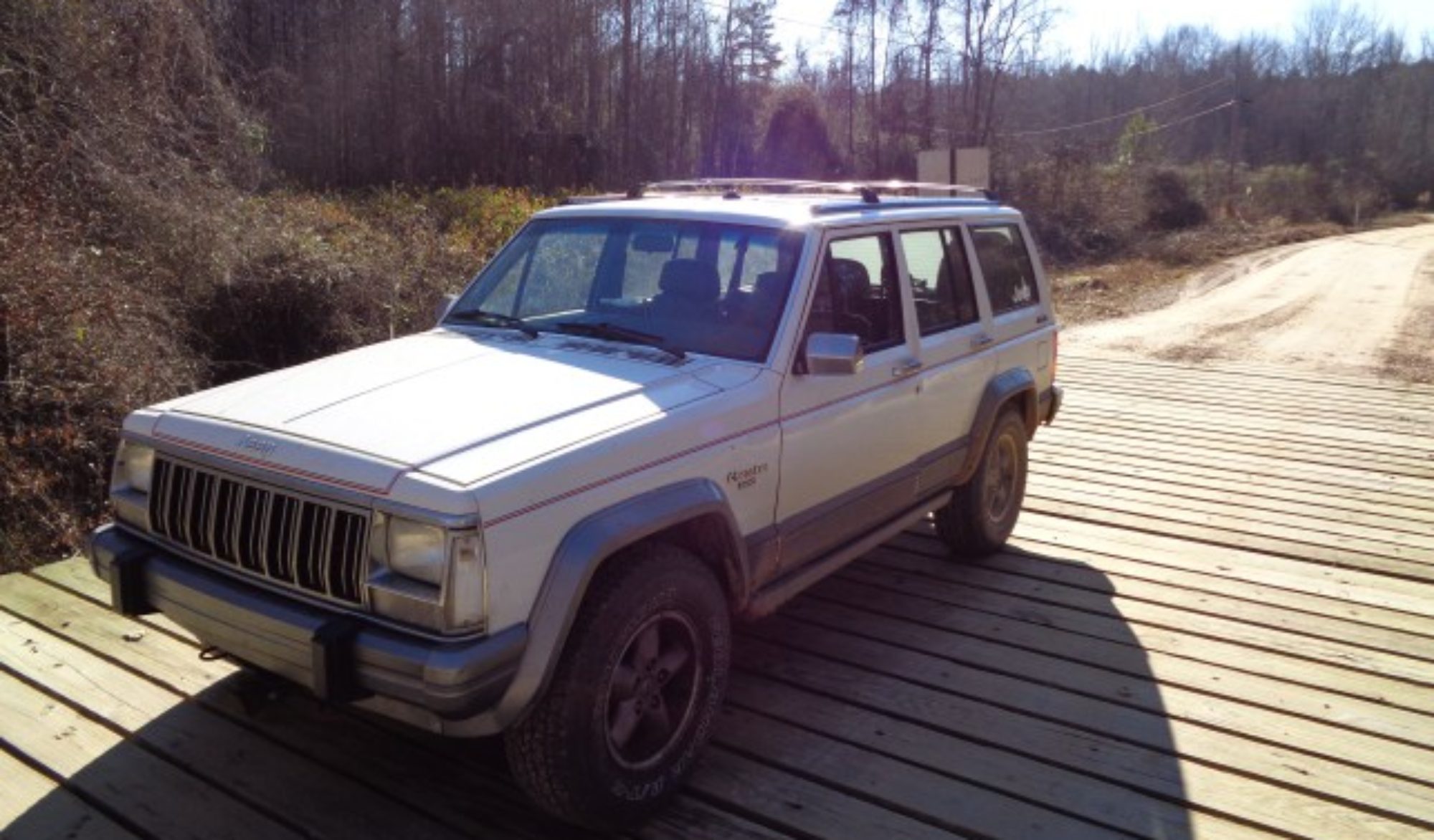
One of the things that first appealed to me about the Jeep Cherokee is that they are cheap to modify for off road use. I was a bit hesitant about whether I would enjoy off road driving so I started by building my Project Cheap Jeep Cherokee.

I found I really enjoyed off roading with my Cheap Jeep. At the time I was rally racing a Jeep Cherokee but the races on the east coast had all but disappeared. I then decided to convert the race car into a Cheap off road Jeep.

I started with a cheap lift kit from JCW. I got some cheap tires off an old F150 mudder truck. I scavenged as many parts as possible to make sure my off roader was a true Cheap Jeep Cherokee even if it did have a full racing roll cage and a 4.7L Stroker engine.

The recent cash for clunkers may have taken a few good cheap jeep project Cherokees off the road. However, some of these will find their way to lots like Pull a Part were we can get plenty of good parts for our Jeeps.

Searching ebay, there are always lots of cheap Jeeps available. See a sample of listings below:

93-94-95-jeep-grand-cherokee-temperature-control 93 94 95 JEEP GRAND CHEROKEE TEMPERATURE CONTROL
US $25.00
Auction Ends: Tuesday Mar-16-2010 7:43:23 PDT
  | Watch this Item
99-00-01-jeep-cherokee-temperature-control-w-ac 99 00 01 JEEP CHEROKEE TEMPERATURE CONTROL W/AC
US $30.00
Auction Ends: Tuesday Mar-16-2010 7:43:55 PDT
  | Watch this Item
93-94-95-96-jeep-grand-cherokee-temperature-control 93 94 95 96 JEEP GRAND CHEROKEE TEMPERATURE CONTROL
US $25.00
Auction Ends: Tuesday Mar-16-2010 7:44:16 PDT
  | Watch this Item
2004-jeep-grand-cherokee-power-window-regulator-lt-rear 2004 Jeep Grand Cherokee POWER WINDOW REGULATOR LT REAR
US $47.99
Auction Ends: Tuesday Mar-16-2010 7:44:37 PDT
  | Watch this Item
99-00-01-02-03-04-jeep-grand-cherokee-wheel-hub-bearing 99 00 01 02 03 04 JEEP GRAND CHEROKEE WHEEL HUB BEARING
US $42.95
Auction Ends: Tuesday Mar-16-2010 7:44:39 PDT
  | Watch this Item
94-95-96-jeep-grand-cherokee-crankshaft-position-sensor 94 95 96 Jeep Grand Cherokee Crankshaft Position Sensor
US $55.95
Auction Ends: Tuesday Mar-16-2010 7:45:12 PDT
  | Watch this Item
1999-2004-jeep-grand-cherokee-headlights-2000-2002-2003 1999-2004 JEEP GRAND CHEROKEE HEADLIGHTS 2000-2002 2003
US $126.00
Auction Ends: Tuesday Mar-16-2010 7:51:32 PDT
  | Watch this Item
jeep-grand-cherokee-93-95-96-97-98-brake-rotors-pad-f+r Jeep Grand Cherokee 93-95 96 97 98 Brake Rotors Pad F+R
US $146.99
Auction Ends: Tuesday Mar-16-2010 7:54:34 PDT
  | Watch this Item
jeep-grand-cherokee-99-00-01-02-04-brake-rotors-pad-f+r Jeep Grand Cherokee 99 00 01 02-04 Brake Rotors Pad F+R
US $159.99
Auction Ends: Tuesday Mar-16-2010 7:55:05 PDT
  | Watch this Item
jeep--cherokee-laradeo-locked-and-lifted Jeep : Cherokee Laradeo Locked and Lifted
US $4,050.00 (10 Bids)
Auction Ends: Tuesday Mar-16-2010 7:55:42 PDT
  | Watch this Item

Ed McMann, Farrah Fawcett and Michael Jackson

Friday, June 26th, 2009

Celebrity deaths and the meaning of life

This week three major icons of my youth have passed away. Ed McMann, Farrah Fawcett, and Michael Jackson.

I have learned that events like this have a deeper meaning in life. Each death represents loosing a part of my self. I am looking into what each of these represent to me.

I mostly remember Ed McMann as being the guy with the big checks from Publisher’s Clearing House. I guess to me he represents the quest for easy money. Money from winning a sweepstakes rather than earning if by creating and delivering value. This part of me needed to die to help me learn how to make money. If I won money randomly, I would not know how to make more and would still be stuck in a scarcity mentality.

I most fondly remember Farrah Fawcett as the pin up girl. Her perky posters were every where during my pubescent years. And the popular girls copied her hair style. To me she represented the girls who were totally out of reach. My childish ideas of relationships made me think the only way to attract a girl like that was to have fame or fortune or both. This was the idea pushed on my by the marketers who used her photo to sell their products. “Buy our widgets and have a shot at this girl.” Now, I know that no woman is out of my league. People are just people and we all have the same basic needs and desires. It is simply a matter of generating attraction and has nothing to do with possessions or position.

I was never really a fan of Michael Jackson and I was somewhat surprised at how popular he was. I remember him as part of the Jackson Five. I never paid much attention to him when he painted his face to look like a clown. I guess that fact that he had his own amusement park meant that he never really grew up. He really just wanted to be a kid. And that is how I most fondly remember him: The little spunky kid in the Jackson Five upstaging his older brothers.

Combined, these deaths all seem to represent the loss of part of my youth. Maybe it is time to let go of some of the childish ideas that have been holding back my progress. I need to let go of the idea that some things are out of my reach. I need a bigger vision for my business. No one is going to bring a big check to my door; I have to go create my own. There is nothing wrong with my being a kid at heart as long as I realize I am also capable of making my own decisions and accepting responsibility for my own actions.

All week long, I have had the son Barracuda by Heart running through my head. I read today where that song was written in response to their manager trying to force the band to go in a direction that did not feel right to them. I think that is what is happening in my business. I have to choose the path that feels right to my heart. I am trusting that the money will come. Maybe not in the form of Ed McMann bringing me a big check, but it will come.

I may have to make some side trips along the way, but I will always be pursuing my true path. Having multiple streams of income is a good concept to work with as I do tend to get bored with doing the same thing all the time. So for now, I plan to continue building a safety training program, giving advice on Jeep repair, learning about dog behavior and studying metaphysics. Somehow, they all will fit together.