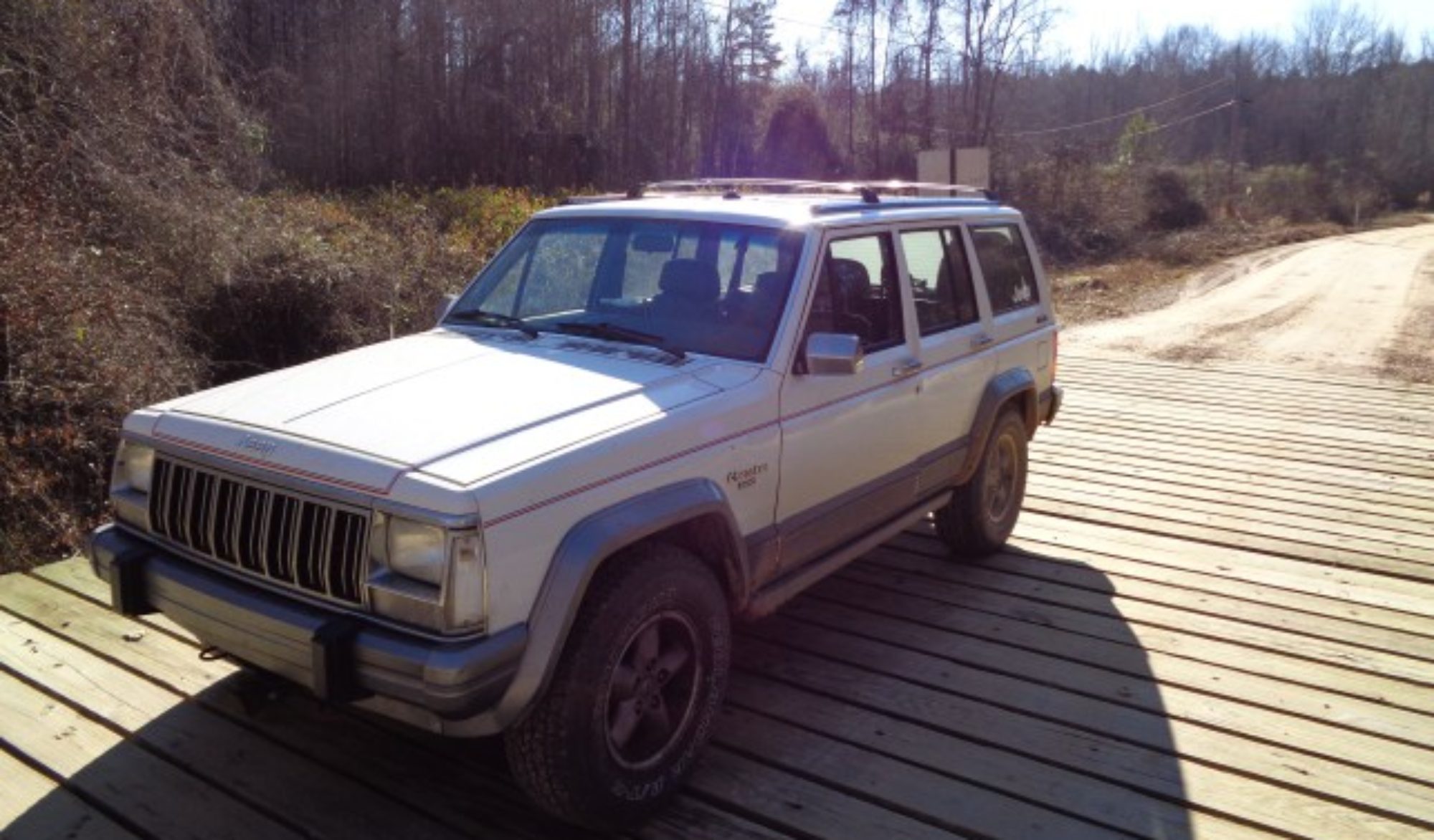
Power Steering pump pulley removal and installation

Power Steering pump pulley removal and installation

When replacing a power steering pump on a Jeep Cherokee, you will have to remove and replace the pulley. If you buy a new or rebuilt pump, it will not come with a pulley nad you will have to reuse the original. Also, there are three bolts on the bracket that are very hard to remove with the pulley in place.

Begin by securing the pump in a vise. You will need a special tool to remove the pulley. The pulley has a removal flange made into the pulley and you will need a tool that hooks into this flange. If you get the new pump at advance auto, they will loan you the tool or you can buy your own so you always have it handy.

The tool had two clamshell halves that fit over the pulling adapter and the flange on the pulley. Slip the sleeve over the two halves to hold them in place. Put the pin in the center of the puller bolt. Turn the bolt to extract the pulley from the shaft.

The new pump will likely come with a bolt to press the pulley back on but the one from the pulley tool kit works much better. Choose the right threaded adapter and screw it into the center of the pulley shaft. Sit the bearing on top of the pulley. Thread the center screw onto the adapter through the bearing. Thread the press adapter onto the center bolt and tighten it to press the pulley into place. Once the pulley is on, remove the threaded adapter from the center of the shaft.

Jeep engine bay fire

Jeep engine bay fire

Rebuilding Mr. Green Jeep

A few weeks ago I got a call that my friend’s Jeep had burned. We think it might have been caused by a power steering hose leak but no one is sure since there was so much damage under the hood.

Her insurance company declared it a total loss and gave her a check for the blue book value minus the scarp value. However she wants her Jeep back.

I have a parts Jeep similar vintage so I have been working to swap parts. However a lot of things have to be bought new.

The whole engine bay wiring harness is being replaced with the one from the donor Jeep. The big difference between the two is that Mr. Green Jeep had ABS and the donor does not. This makes the part of the harness that goes through the firewall on the driver’s side quite a bit different.

We elected to pull the whole harness and intake manifold as a unit rather than trying to disconnect all six injectors. This allowed us to swap the throttle body and all the other burned sensors in one unit.

The owner elected to buy a new brake booster and master cylinder. She also got a new radiator, and power steering pump.

The sticking point right now is the brake lines. The donor Jeep did not have front brake lines. The lines from Mr. Green Jeep are not the right shape for non ABS and they are also damaged from the heat of the fire. I have decided to bend all new brake lines to make sure there will not be trouble with the braking system.

The brake lines are holding up the restoration at this point as the intake such are in the way of getting to the brake lines so they need to be completed before I can move on.

When I went to remove the old brake lines, one of the front wheel lines was seized in the rubber brake hose. I hope I can get it out with heat but I may have to replace the rubber line as well. At the rear, the metal line was seized into the rubber fitting. I had to heat the fitting to get it out. The heat required caused the rubber line to break so that will have to be replaced as well.

I was able to recover the pulley off her melted power steering pump to install on the new pump. I was surprised that the new pump also did not come with a new cap for the reservoir. Luckily, Jennifer’s brother had sent her one from his parts Jeep.

Liquid tire balancing again

Liquid tire balancing again

After running a vibration analysis on my Jeep and finding the tires to be the culprit I decided to try to balance them. My bubble balancer showed they were not too bad so I was sure the trouble was dynamic balance.

Getting the tires dynamically balanced at a local shop costs over $50 so I wanted to find a way to do this myself. I have experimented with liquid balancing in the past with reasonably good results. So I decided to give it a try on these stubborn BFGs.

I first removed all the lead weights. I then removed the valve cores to let all the air out. I then broke the bead on one side to make a place to put in the liquid.

I used some used antifreeze that I had handy. I weighed the heaviest of the four wheel weights and put about that much liquid in each tire. I just poured it between the rim and the tire bead.

I reseated the beads and inflated the tires back to 30 psi. I then put then back on the Jeep and returned the nicely balanced smooth running Goodyears to their owner.

The first test drive showed that the shimmy at 55 was mostly gone. It is so slight as to be able to completely ignore it.

I took it to the interstate and did a quick speed run. I could only hit 70 due to traffic but I was happy to note the mirror shake was gone. The ride was not as smooth as the Goodyears but it is certainly acceptable. I will have to try again later to see how it runs at higher speed.


Tire Rack- Revolutionizing Tire Buying

Bad Battery in a Jeep?

Bad Battery in a Jeep?

Jennifer has had a couple of episodes of her battery being dead when she comes back to her Jeep lately. It has been because she has left something on in the Jeep draining the power but really the battery should have had enough reserve to handle the load.

I suggested she take it to a local chain parts store to have the battery tested thinking that the battery may still be under warranty. They first informed her that the battery was out of warranty.

They proceeded to “test” it and told her not only was the battery bad but so was her alternator. I told her to drive it the short distance to her home and I would check it later. I would come and jump start her if necessary.

I was in the process of pulling the alternator from a parts car when I remembered that the alternator should throw an error code if it is bad. I called her and she confirmed that there was no check engine light. I left the alternator in place.

The next day, I took a spare battery and swapped it into place. In the process, I noticed that one of her battery terminals was very corroded. The spare battery performed about the same as her battery had in starting the Jeep and running the head lights.

I checked the voltage. On either battery, the voltage was just over 12 with the lights on. With the engine running it jumped to 14.5 or so indicating that the alternator was doing exactly what it should be doing. I noticed that the spare battery lost voltage faster than her battery with the engine off.

I swapped back to her original battery and cleaned the battery posts with a battery post brush. I also cleaned the negative terminal and replaced the corroded positive cable. Her Jeep now starts up briskly. The voltage gage on the dash reads slightly higher as well.

We will have to watch it for a few days, but I suspect her battery troubles are cured.