Archive for the ‘Jeep’ Category

Jeep Cherokee Front Brakes

Wednesday, February 22nd, 2012

Jeep Cherokee Front Brakes

This week I once again replaced the front brake pads and rotors on my Jeep Cherokee. I managed to catch them this time before the lining of the pads wore down to the metal. However, I found I still needed to replace the rotors because they had worn. There was actually a lip at the outer edge that made removing the calipers difficult.

I considered having the rotors turned. However, since it costs $16 to turn the at the machine shop and it takes two trips to town to drop them off and them pick them up later, I simply elected to buy new ones for $24 each.

I lifted the Jeep and removed a wheel. I then removed the two retaining bolts that hold the caliper to the knuckle. I had to use a pry bar to separate the pads slightly to get the caliper to come off over the lip in the rotor.

Once the caliper was off, I pried off the outer brake pad. I then used a C clamp to press the piston in before removing the inner pad from the piston. I then put new Duralast Gold brake pads that I got as free replacements at Autozone. I like the stopping power and feel of these pads and I really like the way my local store handles the warranty on the pads. I just swap the worn ones for new ones.

I then cleaned up the protective oil form the new rotor and set it in place. The guy at the parts counter had warned me that if I touched the rotor after cleaning the oil from my hands might cause it to warp. I have never experienced this problem but I heeded his advice anyway and cleaned the rotor again after it was in place on the hub.

I inspected the slide pins and mounting hardware. It all seemed OK, so I slipped the caliper into place over the new rotor. I tightened the two mounting bolts and put he wheel back in place.

I repeated the procedure on the other side. However on the second side, I pried the pads apart before loosening the caliper bolts as it made it easier to pry on the caliper. I don’t think I have ever had rotors wear quite like this before.

With the wheels back on and the truck lowered back to the ground, I pumped the pedal a few times to move the pistons out to contact the rotor before moving the Jeep. I made sure not to press the pedal further than normal while doing this to reduce the chance of damaging the master cylinder seals on trash that may have accumulated in the end of the bore.

The Duralast pads do not require any special bedding in process. I just make sure I don’t stop completely while they are hot for the first few miles. If I do have to come to a complete stop with them warm, I use a creeping motion to make sure that the heat is dissipated throughout the rotor rather than concentrating it all in one place. After ten to twelve stops, I could feel that the pads were nicely bedded in.

Rewelding the Door Hinge on a Jeep Cherokee

Monday, February 13th, 2012

Rewelding the Door Hinge on a Jeep Cherokee

I previously welded the door hinge on this Cherokee a while back. I am not sure what abuse it has gone through but it came back to me this weekend with the door tied in place with a rope.

On initial examination, I found that the latch had tripped and was not allowing the door to close. I pressed the release button on the door handle and used a screwdriver to flip the latch back to the open position. I was then able to carefully close the door and it latched properly.

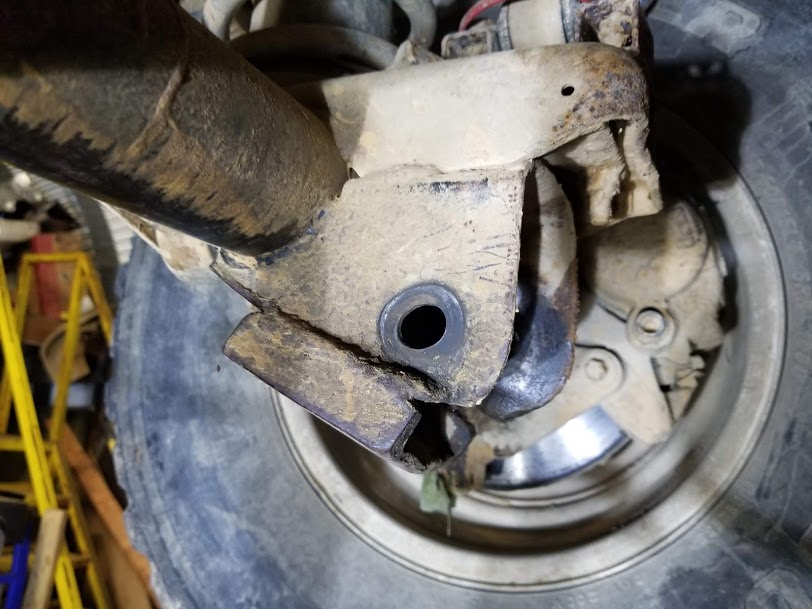
I removed the fender and examined my old welds. The old welds had held it had just broken further out. Possibly in the heat affected zone at the edge of the welds.

I spent quite a bit of time with both the angle grinder and my small air grinder to clean up the area around the break. I again used a 2×4 and a ratchet strap to compress the weather stripping. I was then able to press the broken part of the hinge back into place.

With the hinge in the proper position, I prepped my MIG welder. I started by adding a bead on the bottom hinge that was now beginning to crack. I then began working with the upper hinge. I had trouble getting a good bead at first because the thin sheet metal would burn away rather than bond to the weld. After some adjustments to the voltage on the MIG I was able to get the two parts to blend.

One the hinge was welded on three sides; I removed the 2×4 and opened the door. I added some weld to the inside of the hinge.

After it cooled, I sprayed some paint on to reduce rusting. The door closed nicely and latched properly. I then put the fender back in place and aligned it so the door would open and not hit the fender.

Reattaching a Rear View Mirror

Thursday, February 9th, 2012

Reattaching a Rear View Mirror

When my mirror fell off while racing the Rallye de Parris, I causally said to my co driver, “Whats a behind me is not important.” The video shows me tossing the mirror to the back and it hitting the camera lens. The remainder of the video is much better without the big mirror in the way however.

The mirror was tossed into the tool box and forgotten. Now that the Jeep is used for Off Roading, it is nice to see what is going on behind me. I have mounted a nice big mirror on the fender for when the doors are off. But not having the center mirror makes it hard to see the rig behind me at times.

I found the mirror, but the metal dot that glues to the windshield was missing. I found one at Advance Auto that had glue already on it. I had to rim it a but to fit the Jeep mirror. I just used my grinder to trim it down to fit.

To locate the proper place for the bracket, I measured the location on my street Jeep. I made a small x on the outside of the glass with a marker. I then used brake cleaner to clean the inside of the glass.

I pulled the backing off the adhesive and pressed the dot in place over the mark in the glass. i held it a second or two to make sure it bonded. I then cleaned the mark from the outside of the glass.

I let the glue set for a few minutes before slipping the mirror over metal dot. I tightened the set screw and adjusted the mirror so I could see out the back.

I suspect it will take me a while to get used to it being there again. But it will be really nice one the drive to the trail head and when keeping up with the rig behind me on the trails.

Welding Safety

Thursday, February 9th, 2012

Welding Safety

I grew up around a welding shop. My grandfather was a welder and so was my father. A lot of welding safety has just been second nature for me. However, I have recently picked up welding as a hobby myself and I have noticed that munch of the welding safety advice in the books is overly complicated.

So here are some simple tips for staying safe while enjoying making stuff with steel. This list is by no means exhaustive. I am sure there are many different ways you can get hurt while welding but these basic steps will keep you from the most common hazards.

The most obvious hazard of welding is the light from the arc. Not only is the arc flash hazardous to the operator but to those in the area. A welding hood is the common protection. The shade of the lens needs to be around a 10 so that the welder can see the weld puddle and still be protected from the light. I use a 9 on my MIG welder. Higher amperage arcs may need darker lenses.

The light contains a lot of UV radiation so skin protection is needed as well. The welding hood should cover the face and neck. UV resistant clothes need to be worn over the chest and arms. I have a small tanned V on my chest from forgetting to button the top button on my welding shirt. One last note on UV radiation – it is hard on cotton fabric. Be warned that your favorite pair of jeans can easily be reduced to shreds by UV radiation even if you avoid burning a hole in them.

The second most obvious hazard is the heat. Hot molten metal tends to fly out in all directions from the weld. Long leather gloves are the most common way to protect the hands and wrists. The parts will also be hot just after welding so the leather gloves help in handling the hot parts. Just remember that the heat will deteriorate the gloves over time so don’t handle hot parts more than necessary.

Foot protection is helpful as well. Cloth shoes and laces can catch fire due to molten metal falling on them. High top boots are recommended to keep hot blobs off your ankles.

Hot work also adds the danger of starting a fire. Fire protection needs to be considered for all welding and burning. See http://ezinearticles.com/?Hot-Work-Safety&id=5890147 for more info.

One less obvious hazard is handling compressed gas bottles on a MIG welder. While the gas is inert and non flammable, it still has a lot of stored energy that can be hazardous if the cylinder is dropped and the valve is damaged. If discharged in a confined space the Argon or CO2 can displace the oxygen in the air. So, make sure cylinders are properly secured in use and in transit. Make sure the cap is in place anytime the cylinder is moved.

Be aware of hazards that can be created during the welding process as well. When welding on a vessel like a drum or a tank, make sure the inside space has been purged of any flammable liquids or gases than could have been trapped inside. When welding on a vehicle, check the area near or behind the welding area. Ensure that fuel or brake lines will not be damaged by the heat.

One less common but very painful hazard occurs when welding zinc coated or galvanized metals. Know as metal poisoning, breathing the vaporized zinc will cause a severe headache. The old-time remedy is to drink milk on the theory that the calcium will displace the zinc in the body tissues. The condition can be prevented by having adequate ventilation when welding or by using respiratory protection.

Welding provides a great escape for the worries of the day, as it required total focus for me to make and maintain a quality bead. Following basic safety precautions will ensure that welding is done safely and enjoyably.

MIG Welder Settings

Wednesday, February 8th, 2012

Setting the gas flow rate on my MIG welder has always been a bit of a mystery. The manual is a bit confusing and lacks a set it at this setting suggestion. After some research and trial and error on the welder I have finally found some settings that work for most welding.

MIG Gas Flow rates:
Minimum 18 CFH
Normal 22-27 CFH
Maximum 40 CFH

Also, a voltage of 19 to 23 volts works for most things. Lower on thinner metal or to build up and higher on thicker stuff to get more penetration.