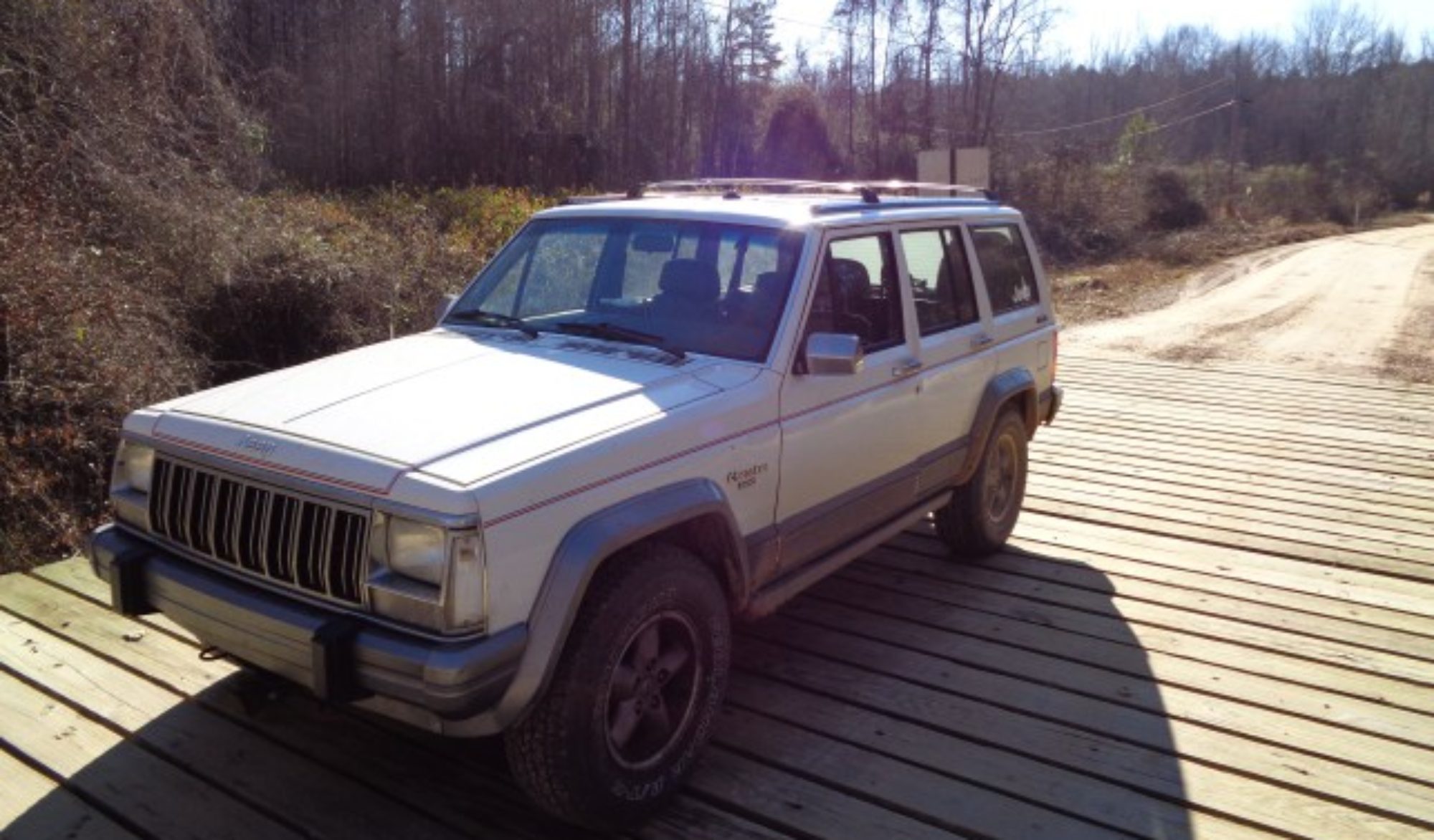
Ball Joint Replacement Jeep Cherokee XJ

This weekend I replaced the driver’s side ball joints in Jenny’s Jeep Cherokee. Ever since our last trip to Harlan, she has had a very loud and very annoying creak in her Jeep when she turned the wheel.

At first I thought it was the track bar because there was some slop at the frame end joint. Also the track bar bracket was loose where it mounts to the body. However with both of these problems corrected, she still had a creak.

It took so me time but we eventually tracked it tot eh ball joints. Most likely the lower joint because that one does not have a grease fitting. To find the squeak, I had her turn the wheel back and forth while I listened underneath. I could tell it was coming from the knuckle. I put my hand on the knuckle and could feel a vibration when it made the noise.

Using the procedure I wrote in the Ball Joint Replacement article, we replaced the drivers side ball joints. I used the hammer more this time and managed not to bend my Harbor Freight Ball Joint press.

With the wheel back on the Jeep is much quieter. There are still some noises but these are more in the normal range for a lifted Jeep XJ with well over 200,000 miles.
[phpbay]Jeep ball joint, 10[/phpbay]

Power Steering Pump – Jeep Cherokee

My power steering pump started growling at Harlan. When I backed my Cherokee out of the barn last week, there was a huge puddle of power steering fluid on the floor. At first I was not sure it was from my Jeep but after cleaning it up and parking the Jeep back inside again there was another puddle of fluid.

While testing the new trails Saturday, I lost all steering assist for a moment and tagged a tree. I decided to put Scuffy away for the day and let Princess play by her self.

I checked the lines and the reservoir for leaks and found none. It must have been leaking through the pump seal.

I have a 94 parts Jeep but the part number for the power steering pump is different for the 88. I looked at the pump and it appeared to have the same mounting bracket. The reservoir is visibly different but the pump itself looked the same. But they have different part numbers.

In the process of removing the pump from the parts donor XJ, I broke off the return nipple. It was very cold and the hose stuck. The brittle plastic snapped before the hose slipped off.

I removed the reservoir from the 94 pump and inspected the connection point. It mounts in a hole sealed with an O ring. The tank is held on by a couple of tapered clips that come off easily with a hammer and punch.

I removed the pump from my 88 Jeep and noticed that the mounting bracket was exactly the same. The pressure hose looked the same. Only the routing of the return hose was different.

Since the donor reservoir was broken anyway, I decided to see if the tanks would swap. I removed the tank from my old pump and saw that it had the same O ring connection. I simply installed my old tank on the donor pump. I even used the bracket from the donor since it was easier to leave it assembled to the pump.

With it all bolted back up, I filled the reservoir with fluid and started it up. There seem to be no leaks. There was a bit of fluid slung off the belt but I hope that was from the old leak. I will give it a full test run later.

I was very happy to have saved $170 that a new pump would have cost. I was also happy not to have to remove and replace the pulley.

[phpbay]jeep power steering, 10[/phpbay]

Trail Maintenance and Building a new Trail

Building a New Trail

This weekend I decided to do some trail maintenance and build a new trail. The recent had blocked one trail and a couple have been blocked since last spring.

My chainsaw has a bad ignition module so I borrowed my Dad’s chainsaw. His starts and runs much better than mine.

We began by cutting down a tree that was leaning across the trial we call Wedgie. This trail drops into a huge V notch and then makes a steep climb. We also opened up the top of the trail so that the off camber turn over a tree root is optional.

This trail has given Jenny’s Jeep a challenge in the past but now on her new 33” tires she made it across the V notch easily. On the return trip dropping into the notch from the steep side, she did tag her bumper into the opposite bank but she pulled through easily.

Next we reopened the loop off the campsite that goes to the far corner of the property. This trail has been blocked by two fallen pine trees for a while. We sliced a couple of cuts in the logs wide enough to get the Jeep through.

Next we worked on a new trail. This one includes the steepest hill climb we could find. We call this trail Slickery because in the wet leaves it was very slick. On the opposite side of the hill there is a large tree root at the base that makes the beginning of the climb interesting. We left a small log across the trail for an additional challenge.

On Jenny’s first run back up the hill, she spun in the leaves and dug in. She got sideways enough that she could not back down due to a tree. So we used Scuffy’s winch to get her to the top of the hill. On her next run, she carried a bit more speed at the bottom of the hill and made it up easily.

Now we have to work on naming all the trails so we know where we are talking about. Then we will have to put a GPS in a Jeep and make an accurate map.

[phpbay]chainsaw, 10[/phpbay]

How To Replace a Leaking Rear Wheel Cylinder in a Jeep Cherokee

How To Replace a Leaking Rear Wheel Cylinder in a Jeep Cherokee

The rear drum brakes on Jeep Cherokees are generally reliable and long lasting. While swapping to disk brakes is a popular modification, the rear drums do a fine job of stopping when they work properly.

One common problem as the brakes age is that the wheel cylinder leaks. The wheel cylinder has two pistons that press out on the brake shoes when the pedal is depressed. The two pistons have rubber cups on them that will wear with age. Also, water can contaminate the fluid and cause the lining of the cylinder to rust.

There are several different wheel cylinders used so make sure you get the proper replacement before disassembling the Jeep. The cylinder for the 9” brakes is different from the one for the 10” brakes and the one used for antilock brakes is different from the one used for non antilock.

Begin by lifting the Jeep and supporting the rear axle. Remove the wheel and tire.

Using a 3/8” line breaking wrench, loosen the brake line where it connects to the wheel cylinder. If the line is stuck, try tightening it a bit before loosening it. Heat can help if it is severely stuck. Use care not to damage the metal line. Use a pan or a rag to catch the brake fluid that drains out.

Remove the two 3/8 headed bolts that hold the cylinder to the backing plate. Remove the brake drum. Loosen the brake shoes slightly if necessary.

Using a brake spring tool, remove the two upper brake shoe springs. Pull the front shoe slightly forward and slip the wheel cylinder out around the axle flange. Clean up and fluid that had leaked into the brake drum.

Slip in the new wheel cylinder. Install the two retaining bolts. Reseat the front brake shoe. Replace the springs using the other end of the brake spring tool. Take care to ensure the cable for the automatic brake adjuster is routed correctly and has not fallen out of place while the tension was off.

Reconnect the brake line. Reinstall the brake drum and adjust the tension.

Add brake fluid to the master cylinder to replace what drained out. Bleed the brakes by having an assistant depress the brake pedal while you open and close the bleeder screw.

With the bleeder closed, have the assistant pump the pedal a few times and then hold it depressed. Open the screw and allow fluid to come out. Close the screw and have the assistant repeat the process. Repeat the process and have the assistant note the firmness of the brake pedal as you observe the amount of air in the expelled fluid.

Once the fluid runs clear with no air, tighten the bleeder screw and install the protective cap. Reinstall the wheel and tighten the lugs to the proper torque. Lower the Jeep and top off the master cylinder before driving.
[phpbay]jeep brake, 10[/phpbay]

Torque Converter Lockup troubleshooting – The Red Jeep Saga

Torque Converter Lockup troubleshooting – The Red Jeep Saga

Scott’s almost has the red Jeep ready for paint. But there has been one nagging problem that he wanted to resolve before he put in the effort to paint the truck – the transmission seemed to refuse overdrive and the torque converter refused to stay locked up.

At first the trouble was intermittent. It was especially frustrating that when I drove the Jeep, it shifted fine but when Scott drove it, it would refuse to stay in forth and the converter would not stay locked.

For those of you new to this story, this is a 1989 Jeep XJ Cherokee. It was bought for parts with a burned up wiring harness. Scott has put it back together and it runs and drives better than any other Jeep in our fleet – except for its weird electrical problems that occur from time to time.

Scott first tried swapping the throttle position sensor. No change. Next he tried swapping the whole transmission computer. No change.

We tested the resistance across all the transmission control solenoids. All were within spec.

Next we decided to use the diagnostic procedure for the later model Jeeps even though this is a Renix Jeep and uses a different transmission computer. It does however have the same model of transmission, the reliable Asin AW4.

We test-drove the Jeep with the transmission computer unplugged. It worked exalt as expected with first gear only in the 1-2 position, 3rd only in 3 position and OD only in D position. Of course no converter lockup is expected with the computer disconnected.

Next, I rigged up a jumper wire to test the converter lockup. I probed the white wire to the solenoid and the yellow power wire to the computer and made a jumper and had Scott drive us down the road. As I connected and disconnected the jumper we watched the rpms jump and we could feel the converter locking up. So it worked mechanically. Just the computer was telling it not to lock.

This test confirmed my earlier suspicions that the Transmission was actually shifting into over drive and the converter was locking for a second and then as if commanded by the computer it was unlocking and sometimes shifting back to third gear.

Next we brainstormed things that would cause the converter to unlock and read more in the manual about how the converter worked. We found that pressing down on the accelerator should unlock the converter as well as stepping on the brake.

As these two circuits are very different we had to resort back to the older manual with its less specific wiring diagram. We saw that a blue and yellow wire was supposed to carry the brake signal trigger. Having already changed the throttle position sensor we decided to work on the brake circuit first. Inspection of the brake light switch showed only pink and black wires. We took another test run and found that if the brake input wire was grounded, the torque converter would indeed lock up. This test confirmed our theory of the brake input being the trouble.

The wiring diagram was less than helpful has it simply showed the bleu/yellow wire going through a switch to ground. It gave no clue as to the physical location of this switch.

Scott crawled under the dash again and searched until he found the blue/ yellow wire. There was a second switch on the brake pedal above the brake light switch.

We probed the switch and found there was no change in it as the brake pedal was depressed. The switch indicated that the pedal was down all the time.

He pulled the switch out and we found that it would work intermittently out of the Jeep. So I took the switch apart and cleaned it with contact cleaner. Once back together, it worked reliably.

Scott reinstalled the switch and adjusted it to properly indicate when the pedal was depressed. We reattached the original transmission computer and buttoned everything back up.

A tryst drive showed that it work just as it was supposed to. So far the transmission continues to operate properly. A simple solution to a problem that had frustrated Scott for a couple of months now.