Installing a Slip Yoke Eliminator (SYE) in a Jeep Cherokee

Installing a Slip Yoke Eliminator (SYE) in a Jeep Cherokee

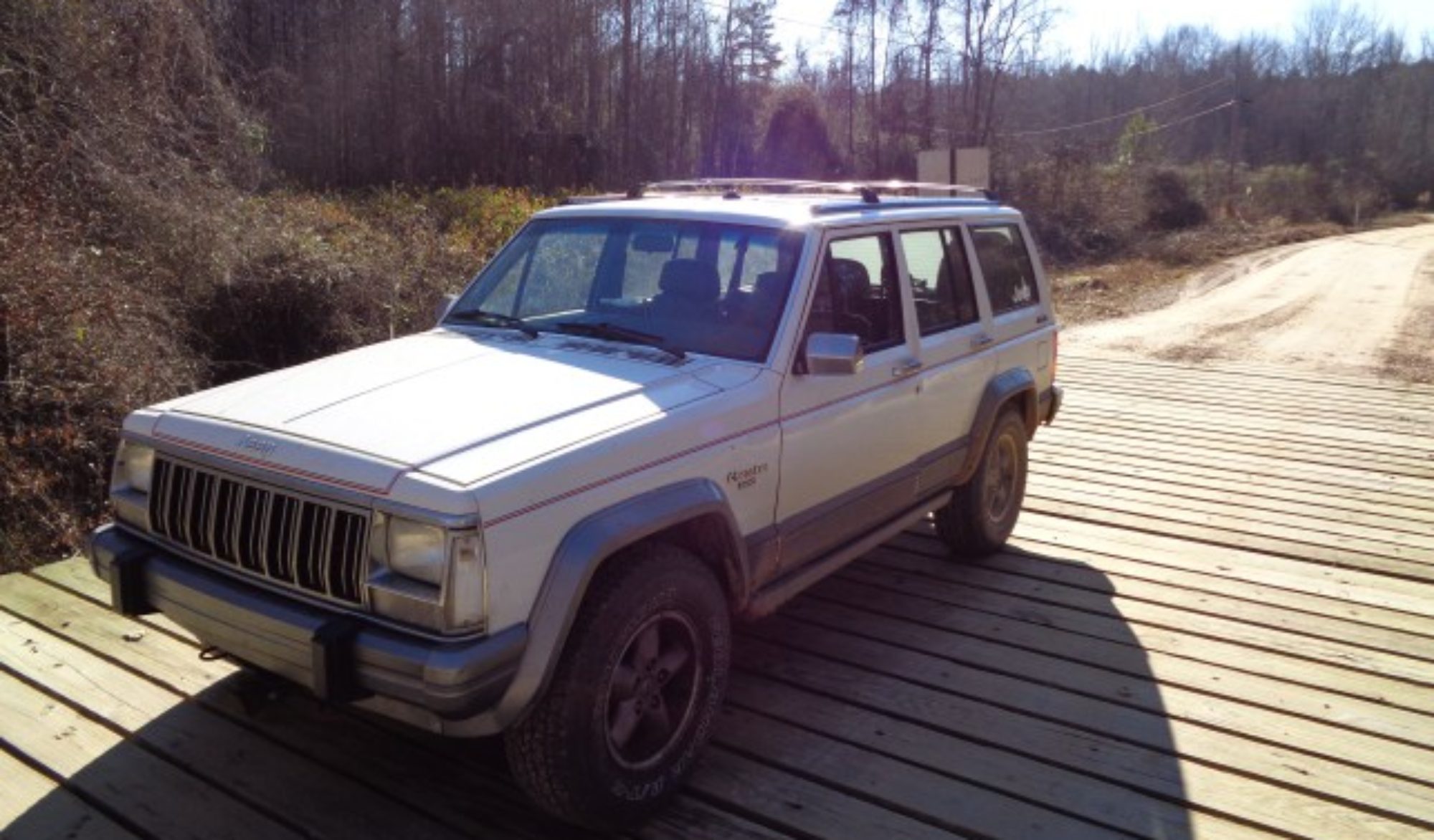
This weekend I installed in Jenny’s Jeep Cherokee the SYE equipped 231 that I built last fall. Our plan was to use a stock front drive shaft in the rear and to remove the transfer case lowering blocks that had to be used to align the drive shaft previously.

Before I began, I coated my hands with Market America Clear shield.

I began by removing the original transfer case. As described in a previous article I installed the SYE in a spare 231 case. The Slip Yoke Eliminator kit can be installed with the transfer case still in place under Jeep.

I began by draining the fluid from the transfer case. Then I removed the rear drive shaft and disconnecting the front shaft from the T case. To remove the transfer case, I supported the transmission and dropped the cross member. I also disconnected the exhaust that the cat flange to get a little more working room.

Next I used a 9/16 box end wrench to remove four of the six bolts that hold the transfer case to the transmission. I used a socket and long extension to get to the two behind the linkage bracket.

With the old transfer case out of the way, I put the modified case up. I had an assistant turn the output shaft to align the splines while I pushed the case into place. Then I tightened the six nuts that hold the case in place.

I lifted the transmission back into place and reinstalled the cross member. Next I reconnected the exhaust and the shift linkage. Then I filled the case with fluid.

The trouble began when I went to hook up the rear drive shaft. The shaft that I had pulled for this purpose would not reach. It was simply not long enough. It also had trouble sliding on the slip joint. So, I rummaged around the barn and found another front shaft. This one slipped in and out easily and reached just fine.

We bolted up the front shaft and took it for a short test run. A very short test run. As soon as we backed it out of the barn, it was obvious that the advice we had read in an internet forum about what shims to use was completely wrong. The drive shaft angle was completely wrong.

I made a few measurements and found we needed 7 degree shims. A call to our local 4wd shop revealed they did not stock them. We chased a few leads they gave us only to find dead ends. As we were ready to give up for the day and possibly the weekend, Jenny used her new Droid phone to research and found Summit racing, 142 miles away, had them. She called and found they had six and eight degree shims in stock but no sevens.

I expected our trip to Golden Mountain was postponed again, but she jumped in my truck and was waiting for them to open the next morning and had shims back at the shop by noon. Determined to go off roading this one is.

I unbolted the spring pack and installed the six degree shims. With it all back together and better aligned, we took it for another test drive. Much better, but there was still a nasty vibration.

Back in the shop I found that the shaft I had grabbed had a lot of play in the double cardon part. So we swapped her front shaft to the rear and made a test run. This time it was vibe free.

I hammered the other shaft apart and greased the splines to get it to slide. Once it was flexible enough I installed it in the front. A quick test run showed some noise but the vibes were at an acceptable level.

Monday we packed up and drove 111 miles to Golden Mountain Off Road Park in Sparta, TN. She had no problem going seventy miles per hour on the interstate following me with my rig on the trailer.

The SYE equipped Jeep handled very well on the trails. Jenny enjoyed the extra clearance that she got from removing the spacers as well.

[phpbay]slip yoke eliminator, 10[/phpbay]

Trail repair of Jeep Dana 30 Axle or U-joint

The Jeep Dana 30 axle will hold up under most conditions, but when you start adding larger tires and lockers as well as driving in more rugged terrain, there is always a chance something might break. Having the right tools and spare parts on board can save the day. A broken axle shaft or U-joint can be changed on the trail in about 20 minutes providing you are properly prepared.

Things you will need include; a jack, a spare shaft, a 13mm twelve point socket or wrench, a 36MM socket and something to turn it. You will also need the appropriate tools to remove your wheel and brake caliper. These vary from year to year and depending on your accessories. A hammer and a spare set of hub bolts will be helpful as well.

If your wheels have open centers, begin by removing the cotter key and the center nut on the axle shaft. This nut is very tight when tightened to specs. You will need either an impact wrench if you have on-board air or a long handled pull bar on the socket. If you have a closed center wheel, you will have to remove the wheel and have someone hold the brake while you loosen the nut.

Support the vehicle and remove the wheel. Remove the brake caliper and support it on the control arm. Try not to let it hang by the hose. Next, remove the brake rotor.

Using a 13mm 12 point socket, remove the three bolts that hold the bearing to the knuckle. The bearing will likely be stuck in the knuckle. My favorite way of removing it is to screw in some disposable bolts that have the same thread and hammer on the bolt heads. Once you hit the bolt head with a hammer, you will not be able to put a wrench on them in the future. I carry a set of bolts for this purpose in my axle repair kit.

If you don’t have spare bolts, you can still tap the bearing out using a hammer and pry bar. Try not to hit on the wheel mounting flange however as this can damage the bearing.

Slip the bearing out and then remove the broken shaft. If part of the shaft remains in the axle housing, use a magnet to remove it. If you can not pull it out with a magnet, you can also remove both shafts and push it out with a stick or long metal rod.

If you have jacked up the side you are working on high enough, you will not spill any axle grease. Even with it level, there should only be a small loss.

Slip in the spare shaft and check for any other damage. Put the bearing back in place and secure the three bolts. Place the rotor back on the hub and secure the brake caliper. Mount the wheel then tighten the center axle nut. Replace the retainer clip and cotter key.

Pump the brake pedal a couple of times to remove any slop that may have been introduced by removing the caliper before attempting to move the Jeep. Now get back to wheeling!
[phpbay]jeep axle, 10[/phpbay]

Automatic wheel balance

Balancing tires

I have dealt with many different ways to balance tires since I started mounting my own tires several years ago. I have had very good results using a simple bubble balancer and lead weights clamped to the rims.

I have considered purchasing a spin balance machine on several occasions but the cost of the machine has deterred me considering the small number of wheels I balance in a year. I can pay to have several tires balanced for the cost of a machine. Also, for most tires my bubble balancer provides acceptable results.

I have studied various methods of automatic wheel balancing for years as well. As the tire wears, the balance changes. And short of taking the tire off the Jeep and rebalancing it, there is nothing else that can be done using the clam on wheel weight method.

I have looked at the rings full of mercury that bolt on the back of the wheel. I have studied the sand and ceramic dust methods used on semi trailer tires. However the simplest method for me to implement would be to add a liquid to the tire.

Looking at the mathematical proof of the physics behind the sand method, I theorized that any fluid would do the same. The material tends to move to the light spot as centripetal force takes over automatically balancing the tire as it rotates.

This week I came across the idea test subject. In the past I was fighting other vibrations at the same time such as bad bearings or U joints. This time however, my truck was running smooth and I had a tire with a big chuck of rubber missing.

Running the tire with no weights produced a huge bounce that could be felt at speeds over 40mph. The Jeep was un drivable at over 60MPH.

The first test was to balance it with conventional lead weights in the bubble balancer. It took slightly over 280 grams of lead on the rim to balance the tire. It was difficult to get that much lead on the wheel and on the test run one of the weights came off. However it did produce a smooth ride.

The next test was to replace the lead with a liquid. I did not want to use water as in freezing conditions it would make a block of ice in the low part and create a huge imbalance. I chose instead a 50/50 mix of antifreeze and water.

I popped the bead on the tire and poured in 290 grams of the balancing liquid. I remounted the tier and took it for a test run.

The initial test run showed a nice smooth ride. I was not able to exceed 60MPH on the test run due to road and traffic conditions but the ride was noticeable smoother than with the lead weights.

I plan to further test the liquid wheel balancing method to see if it will automatically balance all wheels. The math shows that it will work with tires that have dynamic balance problems as well. I can’t deal with these on my bubble balancer so if the liquid method of automatic wheel balancing works, I will not ever have to buy a balancing machine.
[phpbay]tire balance, 10[/phpbay]

Jeep Cherokee Factory Service Manuals

Get Professional-Quality

When making repairs to the Jeep Cherokee the Factory Repair Manual is a valuable resource. I keep a copy in the shop for reference. I also keep a digital copy on my office computer so I can read up on a job before I begin.

http://www.greatlakesxj.com/tech.html

The Haynes Jeep Cherokee Manuals are also handy for some quick reference data like torque and clearance settings that can be hard to find quickly in the Jeep factory service manuals.

[phpbay]jeep manuals, 10[/phpbay]

Always Use New Valve Stems

Always Use New Valve Stems

When I mounted Scott’s tires a few months ago, I did not have any valve stems in stock and I did not want to make the trip into town to get some. The ones in the rims looked fine so I just left them in place.

Then last week, Scott had not one but two valve stems break off due to the rubber cracking.

Last night I swapped in new valve stems for him. I broke the bead on the front side and used a pair of diagonal cutters to cut out the old valve stems. I pressed new ones in place and aired his tires back up.

I put them on the balancer for a tune up of the balance while I had them off.
[phpbay]valve stems, 10[/phpbay]