Forty Nine

Imagine cruising down the interstate enjoying the view through a big glass windshield. The stars are bright and your destination is miles away. You are driving along with out a care in the world. Everything is going well and you expect to arrive at your destination at exactly the scheduled time. Music plays softly in the background and the clatter of the engine combines with the roar of the tires on the pavement to allow you to settle deep into the warm comfortable driver’s seat.

Then suddenly your vision is blurred and glass shatters in front of you. A large lump of something lands in your lap as you try to control your bus and protect the precious cargo of passengers behind you. Someone has just gotten their jollies by dropping a large object from the bridge above you. You safely pull the bus to the side of the road and inspect the damage. Miraculously you are still alive. Just a few cuts and scrapes.

Glass is scattered through out your bus but none of the passengers are seriously injured. Everyone is OK but you will not make your destination on time. And your bus is going to need some serious repairs. It could have been worse. Like it was for a woman a few years ago who had a stone dropped through her from possibly the same bridge. She died from her injuries.

So it could be worse, but still it is pretty bad. What fun it must have been for the hoodlums who tossed the weight into the bus wind shield? Did they even get to see the crash in the darkness? A whole bus load of students returning from a trip are jolted from their peaceful ride by a senseless act.

This story is from this week’s news. A bus load of Lee University students was attacked as it cruised home on I 75 this week.

I read somewhere that life goes through seven year cycles. If so, then this is the end of my seventh cycle. Tomorrow I will be fifty.

I feel like this cycle of my life began with something crashing through the windshield of my life. I was comfortably cruising along in my career as an engineer for Westvaco Corporation. I had comfortable pay. I was good at what I did. People respected me and I was surrounded by friends. While there were many things I did not like about corporate life, I was very comfortable. I had challenges to keep my mind occupied and a comfortable office to go to each day. I was ready to cruise on auto pilot to retirement.

Then, suddenly, my dream was shattered. The plant I worked at was closed. There was some fall out but I was not really injured. Just a few scrapes. The impact reverberated through the other parts of my life.

Suddenly, I was faced with struggling for finances and not feeling very useful. Much of my self worth was wrapped up in being an engineer for Westvaco. When I was not that anymore, I felt like I was nothing.

I tried a few other jobs but none of them gave me any satisfaction. I was not good at them so my self worth went down even more.

My old friends drifted away as they moved on to other jobs. I found my self in a very bad spot. I was alone and felt pretty useless.

In the process of rebuilding myself, I discovered the new thought movement. I discovered it entirely by accident. Or so it seemed.

I began reading books about how to make money and I discovered that there was a common theme in all of them. The idea was that we each create the circumstances that surround us rather than being manipulated by them.

As I studied concepts that were foreign to me such as the law of attraction and the law of mind action, I began to see evidence of their truths. I remembered times when I worked at Westvaco when I had observed this very phenomenon. But not having any basis for causal relationship, I dismissed it like any good engineer would.

I had once made the statement that Westvaco should pay me to be in a good mood because when I was, the presses ran better and if I was in a really good mood, we would set production records. If I came to work in a bad mood, then we had nothing but trouble.

But even after reading the Tao of Psychology, I refused to acknowledge the relationship between my moods and the circumstances. There was no way my emotions could cause outside circumstances was there?

During the last few months at Westvaco, I met a faith healer. The stories he told and the things I observed caused me to believe that there really was more to the universe than what I had learned in school. But I still but my faith in science. But to the true science of mind, just the traditional observational science.

As I studied more and read books by Deepak Chopra, Wayne Dyer, Charles Filmore and others I began to realize that there was something to this science of mind. I began to see that everything I observe is first created in my mind. I also began to understand what Wallace Waddles meant when he said that controlling the mind is the hardest and most import work any man can do.

I am still working on learning to control my thoughts. I often don’t feel that I have the freedom to create with my thoughts. My upbringing in a guilt based religion pops up often causing me to feel that I don’t have the right to even want certain things.

So as I begin my fiftieth year tomorrow, I am moving forward with excitement and wonder. I wonder what will happen next. I have moved way out of my comfort zone and most of my life lines are gone. I will be on my own to create the life that I desire. I can’t rely on anyone to do it for me. I am excited and scared at the same time.

I feel like I have wasted a lot of years getting to this point in life. I have always prided myself on being a fast learner, but in this most important area of life, I feel like I have been very slow on the uptake. Hopefully the pace will pick up and I will learn to release the old constrictions and begin to create a truly happy life that I want.

But first I have to feel like I deserve it.

Torque Converter Lockup troubleshooting – The Red Jeep Saga

Torque Converter Lockup troubleshooting – The Red Jeep Saga

Scott’s almost has the red Jeep ready for paint. But there has been one nagging problem that he wanted to resolve before he put in the effort to paint the truck – the transmission seemed to refuse overdrive and the torque converter refused to stay locked up.

At first the trouble was intermittent. It was especially frustrating that when I drove the Jeep, it shifted fine but when Scott drove it, it would refuse to stay in forth and the converter would not stay locked.

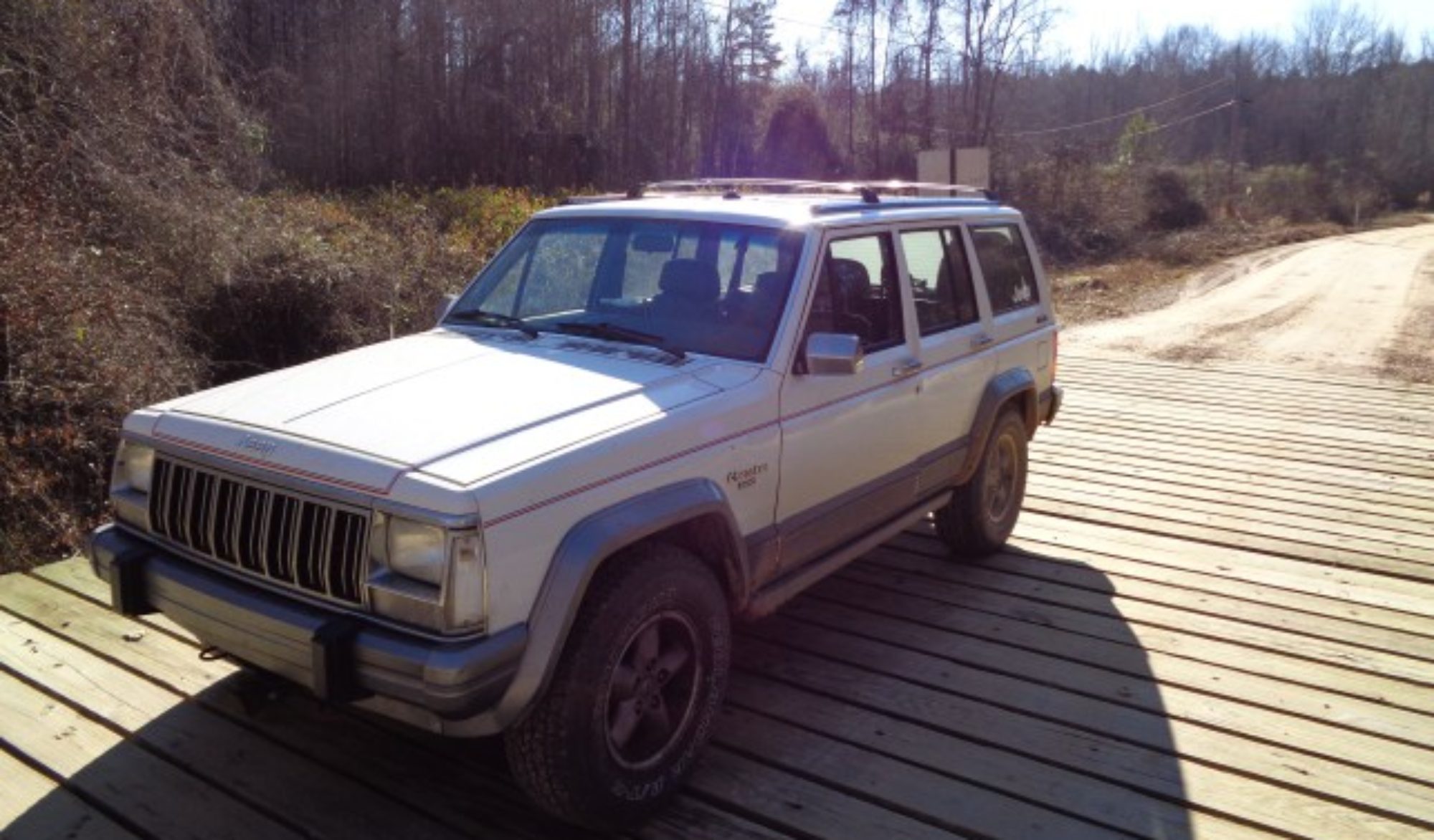
For those of you new to this story, this is a 1989 Jeep XJ Cherokee. It was bought for parts with a burned up wiring harness. Scott has put it back together and it runs and drives better than any other Jeep in our fleet – except for its weird electrical problems that occur from time to time.

Scott first tried swapping the throttle position sensor. No change. Next he tried swapping the whole transmission computer. No change.

We tested the resistance across all the transmission control solenoids. All were within spec.

Next we decided to use the diagnostic procedure for the later model Jeeps even though this is a Renix Jeep and uses a different transmission computer. It does however have the same model of transmission, the reliable Asin AW4.

We test-drove the Jeep with the transmission computer unplugged. It worked exalt as expected with first gear only in the 1-2 position, 3rd only in 3 position and OD only in D position. Of course no converter lockup is expected with the computer disconnected.

Next, I rigged up a jumper wire to test the converter lockup. I probed the white wire to the solenoid and the yellow power wire to the computer and made a jumper and had Scott drive us down the road. As I connected and disconnected the jumper we watched the rpms jump and we could feel the converter locking up. So it worked mechanically. Just the computer was telling it not to lock.

This test confirmed my earlier suspicions that the Transmission was actually shifting into over drive and the converter was locking for a second and then as if commanded by the computer it was unlocking and sometimes shifting back to third gear.

Next we brainstormed things that would cause the converter to unlock and read more in the manual about how the converter worked. We found that pressing down on the accelerator should unlock the converter as well as stepping on the brake.

As these two circuits are very different we had to resort back to the older manual with its less specific wiring diagram. We saw that a blue and yellow wire was supposed to carry the brake signal trigger. Having already changed the throttle position sensor we decided to work on the brake circuit first. Inspection of the brake light switch showed only pink and black wires. We took another test run and found that if the brake input wire was grounded, the torque converter would indeed lock up. This test confirmed our theory of the brake input being the trouble.

The wiring diagram was less than helpful has it simply showed the bleu/yellow wire going through a switch to ground. It gave no clue as to the physical location of this switch.

Scott crawled under the dash again and searched until he found the blue/ yellow wire. There was a second switch on the brake pedal above the brake light switch.

We probed the switch and found there was no change in it as the brake pedal was depressed. The switch indicated that the pedal was down all the time.

He pulled the switch out and we found that it would work intermittently out of the Jeep. So I took the switch apart and cleaned it with contact cleaner. Once back together, it worked reliably.

Scott reinstalled the switch and adjusted it to properly indicate when the pedal was depressed. We reattached the original transmission computer and buttoned everything back up.

A tryst drive showed that it work just as it was supposed to. So far the transmission continues to operate properly. A simple solution to a problem that had frustrated Scott for a couple of months now.

How to make your Jeep Last while enjoying it off road

How to make your Jeep Last while enjoying it off road

Jeeps are huge fun to play with. And the best place to enjoy a Jeep is in the dirt mud and rocks. However use in these environments can take a toll on the Jeep if it is not properly prepared and maintained.

Proper preparation is essential to making a Jeep last off road. While Trail rated Jeep vehicles like the XJ Cherokee and Wrangler are very capable off roaders in stock form, there are some simple modifications that will help them last even longer.

One of the most important preparations is to have the proper tires for the environment. It you are going to be in mud, rocks or dirt, you need a strong tire with deep tread. Having a tie with high void area like a Mud Terrain tire helps get even more traction in all off road conditions.


Get $70 from Michelin

By having good tires, you will be able to approach obstacles with less momentum and reduce stress on the suspension and body work. Having the right tire and not getting stuck go a long way to improving the overall reliability of the Jeep.

Using lower air pressure in the tires when off road will also improve reliability and longevity. Reduced air pressure will allow the tire to conform to the terrain aiding in traction. Lower air pressure will also allow the tire to flex more over obstacles that might otherwise puncture the tire.

The next area to consider is the armor. Rocker rail protection is critical on Jeep Cherokees. The pinch seam on the bottom of the Cherokee is easily susceptible to damage by rocks and other off road obstacles. If the pink seam is damaged, the overall body structure can be weakened. Rocker protection can be simple or elaborate. There are many styles available for sale or they can be easily fabricated with minimal welding skills.

Protecting the under carriage is helpful as well. Factory skid plates were available and provide adequate protection for most off roading. There are also many versions of skid plates available in the aftermarket as well as self fabricated options.

Lifting the vehicle will also allow more clearance between obstacles and the bottom of the Jeep. Lifting also allows larger tires to be fitted so that both traction and clearance are enhanced at the same time. Being able to drive over more obstacles will help your Jeep last longer in off road service.


Pro Comp Suspension - $250 Savings

Even when your Jeep is properly prepared, proper maintenance is important to its long life. The front suspension and steering joints are fitted with grease points so that dirt and water can be flushed out after off road adventures. Use a standard automotive grease gun to force fresh grease in to the joints and to flush out contaminants that may have collected there after each trip off road.

Also, if there is a chance that water could have contaminated the differential fluid or transmission fluid, change these fluids as well. At minimum, follow the recommended change intervals in the owner’s manual.

Keeping the seals in good shape will help keep vital fluids in and water and dust out. Replace oil and grease seals when there is any evidence of leakage.


FREE Shipping! Click for details

Despite your beset efforts to keep parts lubricated, moving parts such as universal joints and tire rod ends will wear out. Inspect these parts frequently and replace them when they show signs of wear. If these parts fail, they can take out other expensive parts or leave you in a very dangerous position off road. Inspect and maintain these joints before and after each off road trip.

Dirt is very abrasive and will be the most damaging element of off roading. Therefore after each trip off road, thoroughly clean the Jeep including the under carriage. Remove dirt and mud that accumulates on the suspension parts to keep them moving freely. Keeping the parts clean will also aid in inspection so that wear can be noticed more easily.

Driving style is also a factor in how long a Jeep will last off road. Knowing how and when to use momentum to get over obstacles is critical to safe and damage free off road driving. Learning from more experienced drivers and practicing on smaller obstacles will help you gain the skills needed to safely drive your Jeep through any conditions.

The Hero Complex

The Hero Complex

One of Carl Jung’s archetypes is the hero. We all love the hero in our stories and movies. He is the one who despite all odds, swoops in to save the day. He puts aside his human vulnerabilities and makes every thing right in the end. Usually he does so with his own brute force or superior intellect.

The hero usually has no knowledge of the subtle forces of the universe working behind the scenes to create the situations he prevails against. He sees only the surface circumstances and his own power to save the day.

Without even realizing it, many of us long to be heroes. We love to help others who are less fortunate. We get great pleasure from pulling some one up or assisting them in some circumstance.

Often the pleasure is heightened when there is a common enemy involved. We often seek out someone or some organization to play the role of the villain so that we can be the hero and rescue some other soul from its evil clutches.

We often join in support groups where we commiserate with others about how we have been wronged by this person or that organization. When we cannot play the role of hero ourselves, we often seek out a hero. We look for someone to save us for the conditions that seem to be inflicted upon us.

What this hero complex misses is the realization that we each create our own reality. We create this though our thoughts both conscious and unconscious. Through what Jung refers to as synchronicity, events take place so that we see our beliefs played out in front of us in what we perceive as reality.

For example if we believe that money is scarce and that we have to work hard for money, we will see ourselves surrounded by poverty. We will create an evil villain out of the rich people around us believing that it is because of their oppression that so many are forced into poverty. We will totally ignore the opportunities that we have to create wealth for ourselves because we believe that the evil villain is repressing us.

Instead we will look for a hero to save us. We will seek a leader who will crush the evil rich people and spread the wealth among the poor and oppressed. Or we may try to be that hero and try to take down the rich. We will seek ways to destroy their wealth so that it will not be a constant reminder that we have not created the wealth that they have.

As a hero we take joy in watching one of the evil rich people come to ruin in either a personal scandal or bankruptcy. What we often fail to notice is that these situations are but temporary set backs to those who understand the workings of the universe. Even if they loose all their wealth, they will use the universal principles to create more wealth unless they too fall victim to he blame game and begin searching for or acting as a hero.

The hero loves to solve problems. He feels good when he overcomes some great obstacle to attain success. People who attain the same success with out the seeming struggle are often looked down upon by those who seek the hero archetype. Success that comes too easy is not looked upon as success. Even if the results are the same.

The belief that life was meant to be a struggle is furthered by fictional stories of all types. The most common form of story telling is that of a hero who saves the day. The more interesting the villain; the greater the hero. Often a large part of the story is spent creating and intensifying the evilness of the villain. Little may be know about he hero but he is considered a great man if he saves the day against the villain.

All we need to know about our hero is that he has some weakness that he has to overcome and that he overcomes the villain the end. We feel better about our hero if he uses his greater strength or cunning skills to overcome a villain than if the circumstances or luck play a large part in the salvation.

By having grown up listening to these stories, we often feel the need to seek out heroes or become them ourselves. We seek validation by becoming either a victim or a hero or possibly both.

Examples can come from every day life as well as form our great stories. Think about a lime when you lost your keys and had someone help you find them. Or remember a time when you had car trouble and suddenly a helpful person appeared as if from nowhere to help you get going again. In these cases we maybe we were the one who saved the day. Think about how good that made you feel.

Rather than seeking to create situations where things just work out and you always know where your keys are and your car is always safe and reliable, we tend to notice these extenuating circumstances more. By putting more emotional energy into these situations, we create more of them.

When we act upon the hero complex the feel good energy released from assisting someone in distress becomes like a drug. You feel useless and unworthy when you are not actively helping someone with a problem. In these cases, the larger part of you works behind the scenes using synchronicity to create more and more situations where you can act as a hero.

As your subconscious gets better and better at creating these situations you may begin to feel overwhelmed. But instead of taking at look at your belief system and working to create a different pattern, you may start looking for your own hero. You begin to act as a victim yourself and continue to create more and more of these situations that require a hero’s assistance.

The hero victim cycle becomes addictive and often there seems to be no solutions. Bigger and bigger problems are created that require larger and larger heroes.

The only solution to the hero complex is to stop look at the problems and start looking at the situations that are desired. This method is completely counter intuitive to both the hero and the victim. In fact it may be impossible for them to comprehend. It takes a huge paradigm shifty to even begin to think about such an environment.

Only through concentrated and conscious effort can the thought process be restructured to stop finding villains and start seeking opportunities. Scarcity thinking plays heavily into the minds of both hero and victim. Only by considering infinite resources can we break out of the hero victim cycle and begin to create the world and circumstances that we desire.

The hero complex is deeply ingrained into western culture and may be very difficult to break in our thought process. Recognizing the hero complex is the first step to ward creating the circumstances you desire rather than fighting against those that we do not desire.

I welcome your comments and would love to hear your examples of the hero complex in your life. Please enter your comments below.

Lowering the Transfer Case on a Jeep Cherokee

Lowering the Transfer Case on a Jeep Cherokee

One common method to deal with drive shaft vibrations on a Lifted Jeep Cherokee is to lower the transfer case one inch to reduce the drive line angles. The pinion is rotated up slightly by using longer shackles or axle shims.

While there are various transfer case lowering kits available in the after market and even one from the Jeep dealer, they all serve the same function: they space the cross member down one inch from the unibody frame rail.

The spacers can be made in a variety of ways. On simple way is to take a piece of 1 inch square tubing or bar stock and drill two holes in it. Another method is to use a stack of washers or a piece of pipe cut one inch long and wrapped around each mounting bolt.

The original mounting bolts must be replaced with longer bolts and the two mounting studs must be removed from the frame. Normally these are replaced with bolts as well.

Bolting a dropped cross member into place can be a challenge. As the transmission engine unit drops it tends to move to the right. Without the studs to align the cross member, it is necessary to hold the cross member in place while starting the bolt into the threaded part of the frame. Because the bolt is now one inch longer, it is easy to cross thread it.

Also, since the cross member hangs down further below the Jeep it is easily impacted by rocks and other obstacles. It is possible to bend the nutsert in the frame making it even more difficult to get the bolts started once the cross member is removed for any reason.

One solution to the bolt problem is to make a longer stud instead of using four long bolts. This will help align the cross member when it is being installed and reduce the change of cross threading. If the nutserts are damaged, you may have to cut into the floor and install a bolt form the top of the frame. Alternately you can weld in a stud from below.

Another problem with the lowered cross member is the angle of the exhaust. The down pipe from the manifold is bolted to the cross member. As the cross member drops, the catalytic converter and the muffler will move down as well if nothing is done to compensate in the exhaust system. The pressure put on the hanger behind the muffler will exceed the strength of the rubber hanger. Also the increased pressure will cause the muffler to crack where the tail pipe exits over time unless the exhaust system is modified.

Having the transfer case sit lower also puts an extra strain on the transfer case shift linkage. If the transmission mount is worn the linkage can slip out of the body mount during off road flexing. When this occurs, the transfer case will not shift from 4wd to 2wd until the linkage is replaced in the bracket.

To eliminate the need to drop the transfer case, a Slip Yoke Eliminator kit is available for the transfer case and when used with a double cardon drive shaft, the transfer case can be used in its original position. See How to install a SYE for more information.

UPDATE: I noticed that the transmission mount for the five speed is about an inch thinner than the one for the automatic. I have not tried it yet but it looks like you could use a manual mount on an automatic to achieve a 1″ drop without lowering the cross member.

[phpbay]jeep transfer case lowering, 10[/phpbay]