Lexan Rear Hatch for Porsche 944

Lexan Rear Hatch for Porsche 944

944lexan

In order to improve the aerodynamics of our Porsche 944 ChumpCar racer, we decided to add a Lexan hatch. The ChumpCar rules require all glass other than the windshield to be removed. For our first race, we removed the glass and ran just the hatch frame. After looking at the other 944s racing against us we decided to add a Lexan hatch like they had.

We ordered the material from Five Star Race Car bodies on the advice of one of the other teams. This is the same material sold by Porsche specialty shops for about $100 less. The material surprisingly comes rolled up in a small box so shipping costs were reasonable.

Since we already had the glass out of the hatch we were able to start right away. Removing the glass from the hatch frame is challenging and requires a lot of patience. I have seen youtube videos of people breaking theirs out but they still had to deal with all the little pieces in the channels. I used an oscillating tool to cut the bonding material and carefully removed the glass. I had a heat gun for some places but mostly where the bonding material was cut, the glass lifted out.

We began by laying out the screw holes making sure there was no more than ten inches between holes. We paid extra to have the material cut to the size of the original rear glass. We may have been better off buying the oversized version as ours was just a little smaller than we would have liked.

We marked and drilled all the holes in the perimeter of the frame. Then we set the Leaxan in the upper groove and pressed it into place. We then carefully drilled through each hole into the Lexan. I found that if the bit ran too fast, the material would melt rather than drill and would refill the holes when the drill bit was removed. After a few holes I had the technique down. The biggest trouble we had was finding the right place to drill the holes. The best spacing away fort eh edge of the window put us in a ridge on the inside of the frame. This caused some of the holes to be angled which gave us trouble later.

We used a hand brace and a large drill bit to cut the counter sinks. We used the screws provided in the mounting kit from Five Star. The kit seemed a good value as it came with the right screws, locking nuts and a drill bit.

Due to the way the nuts hit the back of the frame, the ridge caused the nuts to not seat right. We ended up using a cutting tool to notch the frame at each of the screw holes so the nuts could sit flat. This also allowed us to use the shorter screws in the kit allowing the hatch to fit better when back on the car. Notching the frame took away some strength but once careful handling allowed us to get the Lexan mounted without it bending. Once the Lexan was in place the rigidity returned.

We added the two required one inch wide aluminum strips over the hatch and bolted them top and bottom. We then put all the rubber trim pieces back on the hatch to cover the holes and retain the look and function of the original spoiler.

The new hatch is very light weight and looks nice. We hope the performance improvement will be worth the cost and two weekends of work required to make the swap.

Jeep XJ Stumbles and Stalls

Jeep XJ stumbles and stalls

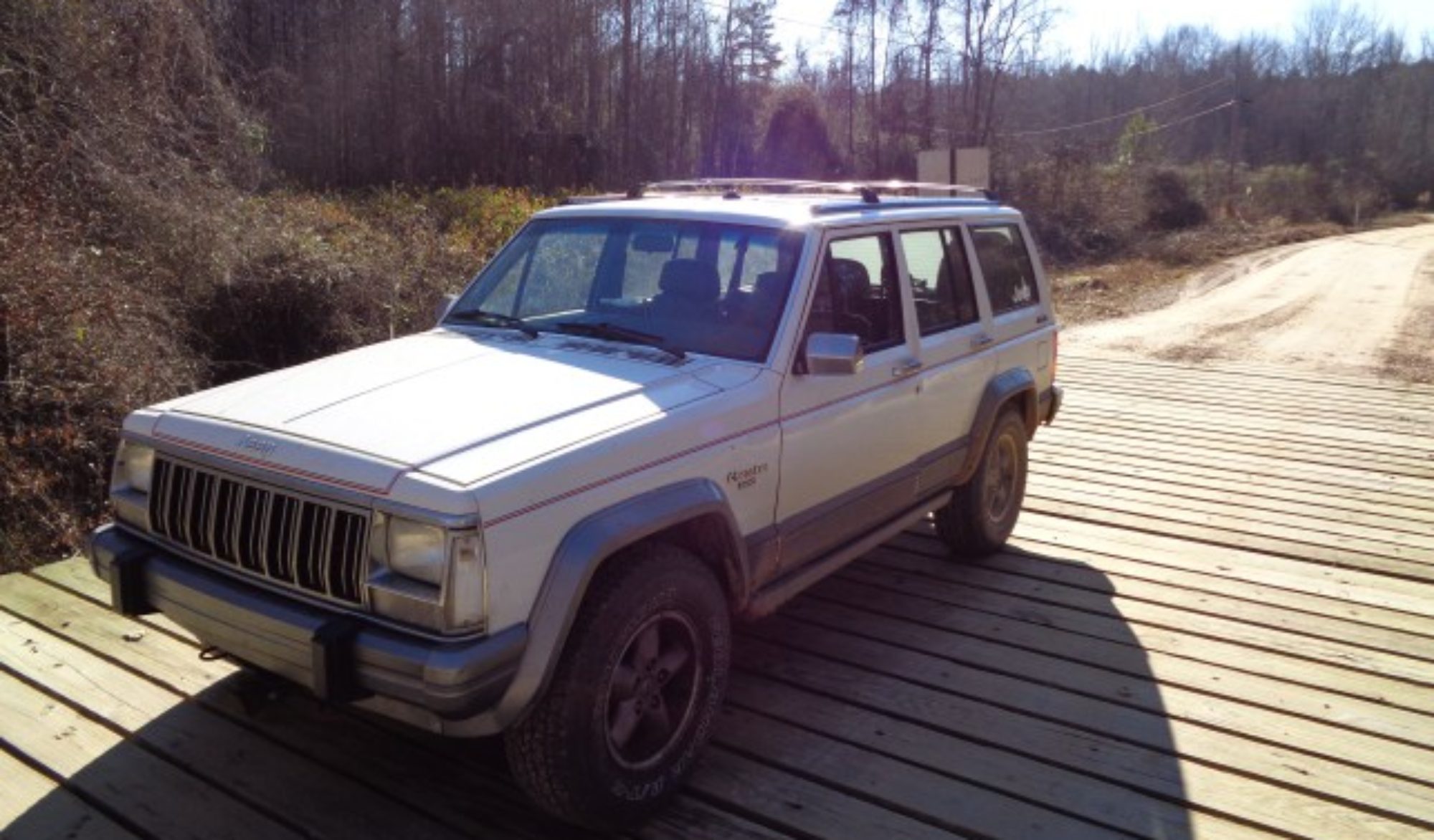
For quite a while now Jenny’s 1992 Jeep Cherokee has had a stumble or hiccup while driving. We have tried changing a lot of parts to make it go away. New crank sensor, fuel pump etc.

On her last off road adventure the stalling got so bad as to be dangerous. At one point the Jeep would not go into reverse without stalling. It became very noticeable that whenever the engine shifted positions it would stall.

We checked all the wring connections that could move and they all seemed fine. We were close to ordering a new distributor.

We made one last investigation and found that moving the main harness that comes from the firewall to the engine would stall the engine. There are no connectors in this bundle so it was a bit of a surprise to find trouble in this loom.

I pulled off the cover and cut off the tape. I began pulling on individual wires to see which one caused the stumble. We soon narrowed it down to the green wire that was spliced to six others.

This turned out to be the power wires for the six injectors. The factory crimp was covered in heat shrink and looked in good condition. Even after removing the heat shrink, there was no visual indication of a problem. However tugging on the wire caused the engine to stumble or stall.

To repair, I cut out eh splice and stripped back the wires. I tinned them with solder. I added a short section of wire and soldered all seven wires to the new piece. I then covered it with tape to insulate.

The engine now runs smoother indicating that even when it was working some injectors were not always firing. So far the hiccups on the interstate are gone and there have been no stalls off road.

Passat Coolant Leak

Passat coolant leak

For months now I have been struggling to find a coolant leak on my 2000 V6 Passat. The leak has gotten so bad that I can no longer drive the car.

The leak appeared soon after I replaced a cam tensioner. However the leak was on the opposite head than the one I removed. I assumed the leak had something to do with parts that were disturbed by removing the head.

The leak was at the back on the engine dripping off the driver’s side of the bell housing. Access to this area is very limited due to all the stuff that comes in here.

I removed the intake manifold and noticed that the two water lines to the throttle body were cracked. I could not see any holes but I replaced them anyway. This change did not help the leak.

I was finally able to track the source by dusting he entire area with baby powder. With the powder in place, I was able to see where the drip came from. I saw it was from the coolant pipe at the back of the engine; however I was still not sure of the exact spot.

I removed the manifold again and used my brake pressure bleeder to pressurize the system. I attached to one of the tubes that goes to the throttle body and blocked the other one with a plug. So I was able to see the drip coming off the quick connect from the heater hose.

I was able to pull the clip and work the hose off the tube. I tried cleaning it up and brushing the metal part. But it still leaked when pressured up. On closer inspection I found, that the O-ring inside the quick connect was flat and hard. I priced the new lines and decided to give a try at refurbishing this one. I was able to use a pick to pluck out the old O-ring and then match up one from my kit.

I cleaned everything up well and put the line back in place. I pressurized the system again and this time it held. I left for a bit and the pressure was still on the system when I got back.

Not to get it all back together and give it a test drive.

Renix no spark

Renix no spark

A few weeks ago I went to start up Scuffy my 1988 XJ and it would not start. The starter spun but the motor would not start. A quick check showed no spark.

I suspected a broken wire but I did not see anything obvious. I began with the usual suspects and checked the connection for the CPS and the ground wire by the dip stick. These both seemed fine.

I then went to check the distributor wiring and found a wire pulled out of the plug. I am not sure this was before or after I unplugged the connector to check it.

I decided to then drag the Jeep into the shop for better diagnosis.

I put a scope on the CPS and it read the correct 500mv. However the wire looked in really bad shape so I ordered a new one. I also ordered a new distributor since the wires were falling out of the connector.

When they arrived, I installed them and expected the engine to fire right up. No such luck. I still had no spark. I hooked up a test light and confirmed the injectors were firing so the computer had to be getting its input signals. Just to be sure, I cleaned the C101 connector at the firewall anyway.

I then started to focus on the coil. I removed it from the ignition control module and tested it. It made a spark out of the system. I pulled the ICM and took it to autozone to be tested. The tech seemed to be unfamiliar with the test procedure but he eventually figured it out and declared the unit bad. He happily sold me a replacement.

I installed that and again no spark. I began to suspect a faulty ECM output. I checked the trigger wire which is yellow and could not detect any pulses. I used a test light to simulate the pulse at the ICM and sure enough the coil would fire.

I was really dreading puling the ECM from under the dash because my racing seats and roll cage make access difficult. However, I needed to test continuity of the yellow wire from the ECU to the ICM.

I began on the engine side since it was easier to access. I began pulling off the wiring harness cover and running my hand along the yellow wire. I soon found where it had been chewed in two.

I quickly spliced the wire and the other one near it that was also cut. The Jeep started right up.

I did leaner several things about the Renix system that I did not know before. It has several differences from the Mopar controller I am more familiar with.

The CPS (crank sensor) on the Renix system has two wires while the Mopar has three wires. The Renix CPS generates a voltage due to eh starter teeth passing the sensor on the flywheel. There is a missing tooth where the coil fires.

The Cam position sensor in the distributor has nothing to do with firing the coil. I have trouble wrapping my head aroun dhti sone but it seesm to be true according toe h Renix control manual. The cam sensor signal helps the ECU determine which of the missing teeth is for Cylinder 1. If the compute can’t get a reference signal it just makes up something. If it guesses wrong, the engine will still run just not as well as if it guesses right. So maybe my broken distributor wire explains why sometime my engine would feel off power and others times run fine.

The Renix coil is fired by a transistor pack under the coil. This pack gets a 12V pulse from the computer when it is time to fire the coil. Timing, dwell etc. are all controlled by the ECU.

The Renix injectors get a 12V pulse to fire and use a common ground wire for all six. The opposite is true for the Mopar that feeds all six with 12V and grounds the one that it wants to fire.