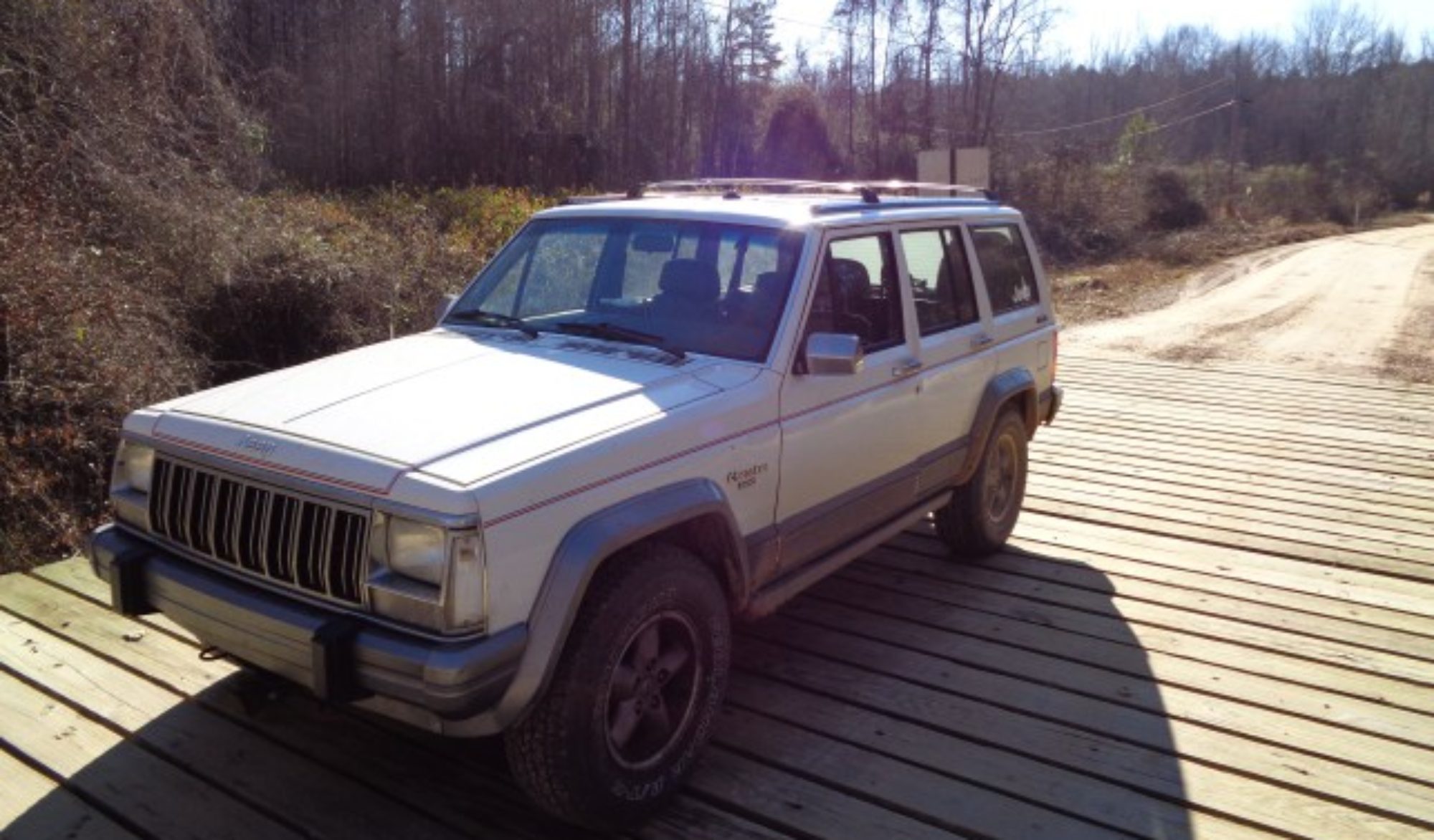
Jennifer’s Jeep has had a loud lifter tick for a while. We finally decided to pull the head and replace all the lifters and push rods. We used the following procedure from Jim Alton to work with:
Mike,
Jen sent me a message and said her lifters need replacing. The head needs to come off unfortunately. Before going that deep, just to eliminate a longshot (but much easier fix), remove the pushrods and make sure they are straight. If any get bent slightly they will be too short and make noise. They have to come out to remove the head anyway, so its easy to check them before getting too deep.
Procedure for lifters (coming from my head…hopefully I don’t miss anything):
-Remove the valve cover.
-Remove the rocker arm bolts. I leave them right in the rocker arms and remove them as an assembly in pairs. Put them somewhere so you can keep them in order. Lined up on a clean bench or table, or even in a divided container like muffin pans.
-Remove the pushrods. Inspect them to make sure the ends aren’t worn. Roll them on a flat surface to check for straightness. If they are even slightly bent replace them. If any are more than slightly bent, this could be your problem- replace them and reassemble, and see if its quiet again. (just a very slim chance this is the problem…most likely, its lifters)
If the pushrods aren’t the problem-
Have new head bolts handy. They are supposed to be “one reuse allowed”, but I always install new. Most part’s stores will have them. They cost a little, but easier and cheaper than ending up with stretched bolts.
-Remove intake manifold. Remove remaining 3 fasteners to loosen exhaust manifold if you didn’t already. Pull the exhaust manifold away from the head slightly using a bungee cord or similar.
-Drain coolant, then remove upper radiator hose & both heater hoses from the engine.
-Remove belt
-Remove 4 bolts holding the A/C compressor top the mount. Don’t disconnect AC lines. Lift the compressor up, flipping it to the passenger side of the Jeep. It should sit over there upside down still attached to the hoses.
-Remove a couple bolts attaching the A/C bracket to the head. You don’t need to remove the whole bracket, just the bolts going into the head. Removing the whole bracket involves removing the alternator.
-If the head has never been off before there is a spot on the firewall that could keep the driver’s rear head bolt from being removed. Bending this over slightly will give clearance.
-Remove the head bolts.
-Lift the head from the engine- straight up, then out. Its HEAVY! This is old American engineering cast iron! Get someone to help if your back isn’t good, or use an engine crane.
-Use a pick to pull the lifters out. Some may be somewhat stuck. I have found letting them drop low, then a quick pull up helps get them past the dry ridge that builds up. You may have to try several times up and down.
Once they are out check the cam lobes for wear. Look for scarring, obvious wear signs. It would be best to have a dial indicator to check for lobe lift, to eliminate cam wear from a possible noise cause, though that would usually lead to a misfire code as well.
While the head is off anyway, I would use a straight edge to check for flatness. Check the length of the head in a couple places, then check corner to corner. If you can put anything larger than a .003″ feeler gauge between the straightedge and the head, the head is warped. Very rarely does this happen on a 4.0, especially earlier years. Also take the time to clean the oil return passages in the head. They are very small, and often have casting flash left making the holes even smaller. Gunk builds up and keeps the oil from draining back as well as it should. I feel this is one cause that leads to blowby in the earlier engines. Just make sure the passages (near where the pushrods go though) are clear.
If everything looks good, lube the new lifters and drop them in. Reverse the removal procedure.
-Clean the block surface and head. I use an air powered scuffing wheel, but a razor blade followed by a Scotch-brite pad will work also. Do the same for the intake & exhaust manifolds and their surface on the head. Clean coolant out of the cylinders and clean up the block as well as you can.
-Set the head gasket in place, then the head, being careful not to damage the head gasket.
-Torque the head bolts, then reassemble everything.
-At the end have 5 extra quarts of cheap oil ready (plus the 6 you will be using), and a filter. Drain & change just the oil before starting the engine, then start up, and run several minutes. Then change the oil & filter. While shops won’t spend the money to do this, I like to. Changing the oil right off gets the coolant out that ends up there during the head removal. Starting it up circulates the new oil and picks up more coolant that is in the block, as well as the material that dropped in while cleaning up the block and head. Changing it a second time gets rid of this. Overkill? Maybe…but it only costs a few dollars for cheap oil, and it makes me feel a lot better.
Jim