The Red Jeep Chronicles – Flat tire in the rain

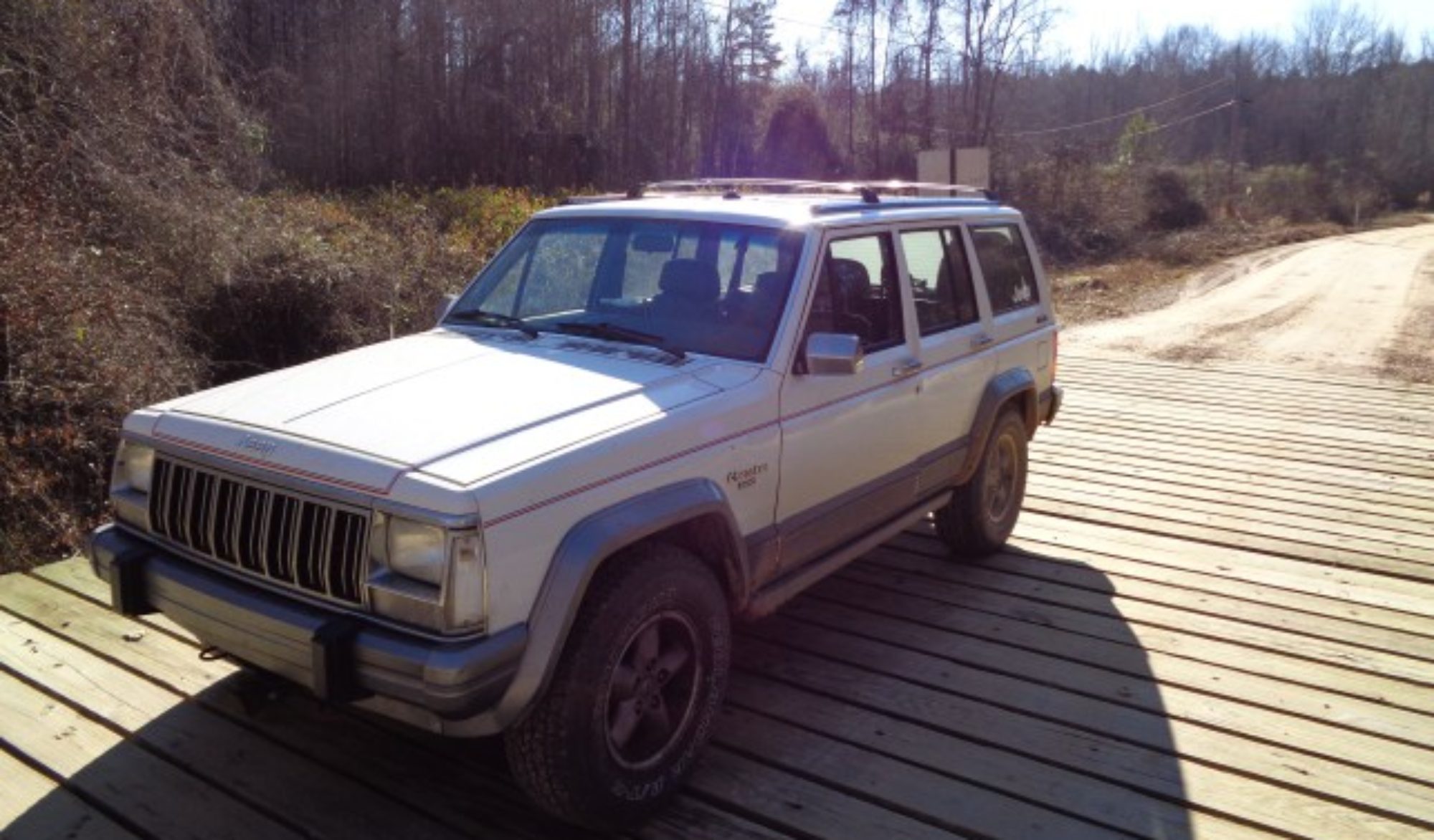
Today, Will and I were repairing a broken radiator hose on his Jeep Cherokee. We decided to take the red Jeep to town for the parts run.

Less than a mile from the house, I heard a whirring noise form the left front tire. I also felt a sudden pull to the left. I looked out the window and the left front tire was completely flat!

I stopped in the road and backed in to a convenient field entrance since this road has no shoulder. I flipped up the seat and discovered that the jack I expected to find there was missing!. I had a spare but no jack.

Just as Will and I decided to just walk to the house, it started to rain. And rain very hard. We were just beginning a conversation with the folks sitting on their porch at the next house up the road when we had to dive for cover in the Jeep.

After the rain calmed down a bit, we decided to ask the folks there for a ride to the house. The fellow was nice and drove us the mile or so down the road.

At the house, I picked up the floor jack and the trailer spare. I also got a long breaker bar and a set of deep well sockets.

Back at the Red Jeep, I noticed that the tire was not just flat but the tread had separated and the sidewalls had split. I am glad I was doing only 30 mph or so when I heard it. The rim was not damaged.

I was really glad I had brought the breaker bar and sockets as the lugs were very hard to get loose. But after some struggling they all come loose and I was able to swap on the spare. About that time, the rain quit.

Will tossed the torn tire into the back of my Jeep and drove it home while I drove the Red Jeep. I guess Scott will be shopping for a set of tires before he can sell it now.

How to Find a Bad Fuel Injector

If your fuel injected Jeep is running rough like it has a miss on one cylinder, the trouble may be a bad fuel injector. Fuel injection is great when everything is working correctly but sometimes trouble shooting the system can be like shooting in the dark. You can’t just remove the air filter and look inside like you can with a carburetor.

I have been working with a 1989 Jeep Cherokee six cylinder recently. The truck did not run when it came to me and I did not know its history.

One I got it running, it had a distinct miss of a dead cylinder. I first checked to make sure it was getting spark to all the plugs. I did this first by using my in line spark tester. This tool flashes when the coil sends fire to the plug. All six were flashing. I then pulled the spark plugs out one at a time and visually inspected them. They all looked fine and all looked the same giving me no clue which one was the trouble cylinder.

On older engines, you could simply remove the plug wires one at a time to see which one did not make any difference in the way the engine runs. However, I have found that you can’t do that on modern electronic ignition systems as the power in the spark plug wire will give you a very uncomfortable zap if you try to remove it while the engine is running. So I don’t use that method on modern engines.

Next I checked the fuel pressure at the fuel rail by connecting my fuel pressure tester to the fitting on the rail. The pressure was within specifications so I moved on to testing individual injectors.

To check the injectors, I used a mechanic’s stethoscope. I placed the tip of the stethoscope on each injector body and listened at idle. On the injectors that worked correctly, there was a very distinct ticking sound. On the injector that was giving trouble, there was no ticking sound. I moved the stethoscope back and forth between injectors a few times to get a clear image of the sound that it was supposed to make when it was working.

Before removing the fuel rail to change the injector, I tested the electrical signal to the injector. I made a simple test lamp using a parking light socket and bulb and plugged it into the wiring harness. Since the light blinked, I knew the injector was getting power and must be stuck or bad. You can also purchase a noid light that will plug into the harness, but for a quick check you can make a simple test lamp like I did.

To test the fuel injector firing coil you can use an ohm meter. Simply disconnect the wiring harness from the injector and place the probes across the two contacts of the injector. An intact coil will read around 15 ohms. However, as seen on this Jeep, an intact coil does not mean the injector works.

Once you have located the injector giving trouble you will have to remove the fuel rail to replace it. See my other articles for how to replace an injector or repair a leaking injector.

Update on the Red Jeep

The Red Jeep Saga Continues….

Sunday I drove the red Jeep to my mom’s for Mother’s Day. On the way there I decided to stop to get her a card. I stopped at a Dollar Store near her house.

When I got back to the Jeep, it turned over slowly at first and then not at all. I did not have any tools or even jumper cables with me. So, I called my Dad to come rescue me.

When he got there, we connected the jumper cables but it made no difference. The starter would not turn at all. I tried the old trick of whacking it with a big wrench, but it would only give a partial turn before it stopped again.

This being a starter that had failed before, I was not entirely surprised. So we pushed the Jeep to across the parking lot away form the door and headed over to steal the starter from Scott’s Jeep that he has conveniently stored at Dad’s garage. We took the battery along to charge it just in case as well.

Having recently written and article on how to change a Jeep starter I was able to very quickly pull the starter of Scott’s XJ Wagoneer and head back to the Dollar General Store parking lot.

Back at the store, I swapped in the other starter while Dad reinstalled the battery above me. It all went very smoothly and quickly. There is plenty of room to work under the Jeep without even having to jack it up. And these are both stock height.

As Dad connected the battery cables, I hit the key. Nothing! We both looked at each other kinda stunned. We had even tested the other starter after taking it off Scott’s Jeep.

I found the one jumper that I had left in the console and began to trouble shoot the starter circuit in my head. My plan was to bypass the starter relay and see what happened. When I reached down to to pull the trigger wire off the relay so I could jump it, I saw it was already loose. It had gotten knocked off when the battery was removed or replaced.

I reconnected the green wire and tried the key again. This time it spun over like it should. We both commented that the engine sounded like it slowed down when it cranked.

After Dad and I cleaned up, I gave Mom her card and sat down and had a nice chat with them. Since we have been playing with old cars and Jeeps for a long time, these adventures don’t really surprise us anymore.

[phpbay]Jeep Starter, 10[/phpbay]

Life in a haunted house.

When I was about 12 or 13 years old, we moved into a rental property in Greenwood Springs Mississippi. It was very convenient for us as it was just a mile or two down the road from property Dad had just bought where he planned to build us a house. In the evenings we would go and work on clearing out the house place and such.

My grandfather, Daddy Straw spent a lot of time with me during the time we lived at this place. He would take me hunting and teach me other skills that a boy my age needed for life in the country.

We had lived there a few months before we started noticing strange things happening. One of the first things I remember out of the ordinary was when I gave my mother a magnolia blossom as a gift. Normally these seem to wilt quickly once cut from the tree but for some reason, this one just never withered. I set it in a bowl of water on the dining room table and it stayed fresh for over a week. We finally got tired of it and threw it out but it still looked as fresh as the day I cut it from the tree.

The next strange thing happened one evening when we were all sitting around the dining room table after dinner. We heard a noise in the kitchen and we all looked up in time to watch the doorknob turn and the kitchen door open. We were expecting it to maybe my Grand Daddy Straw as he sometimes came in the back door instead of the front.

But to our surprise, the door simply closed on its own and no one was there. Then our attention turned to the other door to the dining room. This door led to the rest of the house. Just as before, the doorknob turned and the door opened on its own and then closed again as if a person had just walked through the room from one door to the next.

After a while, we got accustomed to sharing the house with our invisible roommate. We knew to look for missing shiny things under a certain board in the closet and to expect small items to move around when no one was looking. We even decided that our dog was not crazy for jumping on and playing with an invisible friend in the yard.

Never did any of us ever feel threatened by the ghost. We felt she was female and began calling her She. Once, my mother was ill and sleeping alone at the house. She said she felt a presence wake her up and as she awoke, she saw a white figure at the foot of the bed gently shaking her to wake up. Once she awoke, the figure was gone but she realized that the pilot light had gone out on the gas heater and the room was slowly filling with gas. The ghost had protected her.

The only scary time I ever experienced was one day after hunting rabbits with my Grand Daddy Straw; I went inside to put up the butcher knife I had used to clean the rabbits.

I tossed the knife onto the counter near the sink and turned to go back outside to get the rabbits. As I turned around, I heard the knife fall on the floor. I did not think anything about it, I just figured I had missed when I tossed it on the counter. I was more careful as I set down the knife by the sink and turned to go back out.

Again as I turned and headed out the door, I heard the knife hit the floor. Still, I thought nothing of it as the countertops were not quite level and I assumed it had slid off after I set it down. So this time I picked up the knife and carefully placed it on the countertop. I put it all the way back against the backstop near the sink. As I lifted my hand away I made sure it was stable and was not going to slide off again.

This time however as I turned to go back outside, the knife flew across the room and landed near the door on the opposite side of the room. This time, I decided to leave the knife on the floor and go back outside. I am not sure why she did not want the knife on the counter, but she made it very clear she did not want it left there.
How to write safety procedures everyone will follow

Considering Personality Types in Safety Procedures

People are different. Every one looks at life though the lens of his own personality type. By addressing these different personality types, we can create procedures that every one will follow.

Carl Jung defines four different personality types: Feeling, Thinking, Sensation and Intuition. Most personality psychologist use four similar categories, but with different names.

Since Sensation personality types tend to be good at accounting, care taking, collecting data organizing and supervising, they tend to end up in supervisory positions. Since they themselves are good at following directions they often think others are as well. They often don’t understand people who don’t follow instructions. After all, Sensation people follow instructions simply because the instructions are there.

Sensation personality types will not normally question the procedure; they simply want it to be executed fairly and consistently. If you are inconsistent in your enforcement, sensation personality types will follow the procedure simply because it is the procedure. But, if you change the procedure, you better give them some time to prepare as they also like to plan ahead.

Feeling personality types are good at being cooperative, mentoring, teaching and training. So these are the ones you want to use to present the new procedures to the people. They will be more interested in how the procedure makes them feel than what it is accomplishing. Also, in presenting procedures to Feeling personality types, it is important to recognize them as people first and employees second. Adding some fluff to the procedure that recognizes their humanness will win over the feeling personality types while annoying the thinking personality types. So be careful to find a balance.

Thinking personality types will want to know why. They will also be the ones to suggest a better way. Be sure you listen to them. Even if you don’t implement their suggestions, be sure you listen to them if you want them to follow your procedure. Make sure the procedure explains why the procedure is important to the process and how you came up with it. These explanations are very important to Thinking personality types.

Intuition personality types are the ones who pride themselves in not following the rules and can be the biggest challenge to generating procedures that every one will follow. Intuition personality types tend to be risk takers and impulsive. However they also make great leaders so if you get the Intuition personality types to buy in to a procedure they will bring the others along with them. To make the procedures palatable to the Intuition personality types, be sure to add some room for creative expression where possible. Understand their need for variety. Allow some options for them to choose from. In training for a new procedure be sure to include real world examples. Use funny stories if possible to get and hold their attention.

I often see procedures fail because the writer assumes that all people think like they do. And many managers think that “Because I said so” is good enough motivation to get people to follow a procedure. If you want employees to follow procedure when no one is looking, you need to consider the personality types of the employees.